« March 2011 | Main | September 2011 »

August 26, 2011

A "Free Lunch" for Small Business

With more than 14 million unemployed American workers and an unemployment rate stubbornly above 9 percent, perhaps the most vexing economic issue of our day is how to create new jobs.

If we can put these Americans back to work, they will once again be paying taxes instead of collecting unemployment benefits, which will largely take care of our budget-deficit problem. But how can we create new jobs without spending additional hundreds of billions of dollars, on top of the $787 billion spent on the Obama administration’s 2009 stimulus plan, which has failed so spectacularly? What if I told you that there is a “free lunch” with respect to job creation, if only we were to change some simple, yet onerous, employment regulations on small businesses?

I am a small-business owner, but I am also a pointy-headed academic - a professor of finance - who has studied small businesses for almost two decades, so I have a unique perspective on how to create new jobs. My small business needs to hire its first employee. Why is this important? Because new research indicates that almost all new jobs are created by young and small businesses hiring their first employees. That said, I will not be hiring my first employee. Why? Because it is just too expensive. Let’s look at the costs and benefits.

If I am to pay my new employee $20 per hour, or $40,000 per year, how much will it actually cost me to hire this worker? Let’s assume my pay is $125 per hour, or $250,000 per year, which puts me into the bottom of President Obama’s “millionaires and billionaires” earnings bracket that includes so many entrepreneurs. Each quarter, I will have to file IRS Form 941 - Employer’s Quarterly Federal Tax Return. The government estimates it will take me 15.7 hours in recordkeeping and preparing the form each quarter, for a total of 63 hours per year. Each year, I also will have to file IRS Form 940 - Employer’s Annual Federal Unemployment Tax Return. The government estimates that it will take me 12 hours in recordkeeping and preparing the form each year. At my assumed $125 hourly rate of pay, just these five forms will cost me 75 hours at $125 per hour for a total cost of $9,375 per year.

I also will have to pay half of my employee’s Social Security and Medicare taxes, or another $3,000 plus unemployment tax equal to 6 percent of the first $7,000 in wages, or $420. So, to pay my employee $40,000, it will cost me $43,420 out of pocket, plus an opportunity cost of $9,375, for a total of $52,795, or 32 percent more than the $40,000 I had hoped to pay my first employee. Moreover, there are serious monetary penalties should I miscalculate the withholding taxes, not to mention the additional time required to file amended forms. And there are undoubtedly other regulatory-compliance costs that I have overlooked. Now I decide that I will not hire a new employee.

What if we change the rules of the game for the smallest of small businesses? What if we allow small businesses to hire their first one (or two or three) employees as independent contractors, doing away with all of these regulatory burdens? (Currently, this would violate Federal and state employment laws.) The huge fixed costs of hiring a first employee disappear immediately. According to the U.S. Census Bureau, there are more than 20 million zero-employee firms in the United States with almost a trillion dollars in annual sales. If only a fraction of these firms decide to hire their first employee, this could be a game-changer, boosting employment by millions.

What is the downside? Zero. This can be a revenue-neutral deal. My employee would still pay Social Security and Medicare taxes but as an independent contractor, he would be responsible for the full 15 percent rather than only the half that salaried employees pay. I would be willing to pay the employee an additional 7.5 percent to cover these taxes; I would be paying that amount anyway under current rules. The big savings come from the elimination of the reporting burden that frees me up to do productive work for my clients, rather than do unproductive paperwork for Uncle Sam.

NOTE: This entry appeared as an op-ed in the Aug. 26, 2011 edition of the Washington Times.

Available online at: http://t.co/kGh88Sv  
August 20, 2011

Deja Vu: 2008 All Over Again?

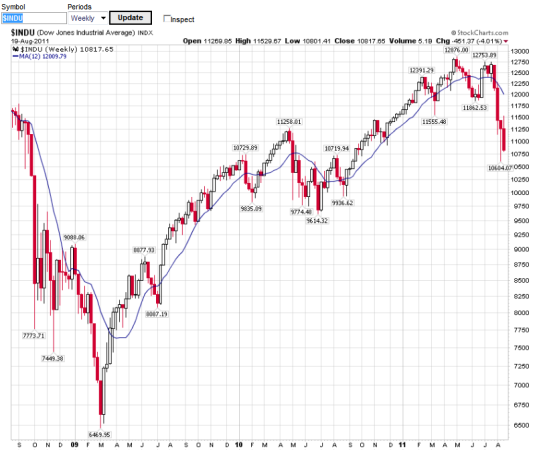
After a five-trading-day respite, the Dow-Jones Industrials returned to a 500-point intraday price swing on Thursday, ending down almost 420 points; on Friday, the volatility was lower but the market lost another 170 points to finish at 10,817, a loss of 4% for the week and 15% from the May high. Similar changes were seen in the broader indices, such as the S&P500, which finished at 1,124, down 5% for the week and 16% from the May high. What is responsible for this collapse in the stock market? Was it those pesky tea-partiers, who “held the government hostage” while demanding serious action on reducing the ever-ballooning national debt? That is what you will hear from pundits on the left.

Dow_Weekly_Candlestick_2011_Aug_s.png

In reality, it is just an end to the “irrational exuberance” that took the stock market up more than 25% from last summer. What was the reason for this bubble? Apparently, investors were betting on an economic recovery in the U.S. Unfortunately for us all, they have been disappointed by a reality check.

Unemployment remains stubbornly above 9%. As of July 2011, the Bureau of Labor Statistics reported that only 140.38 million Americans were working, which was only 204,000 more than July 2010, even though the U.S. population had increased by 1.8 million. The unemployment rate would be even worse had not almost a half-million workers given up and left the labor force. Clearly, the labor market is no healthier today than it was a year ago; in fact, it is worse and likely to deteriorate further as recently announced corporate layoffs take place in coming months.

The housing market is faring no better than the labor market. Residential mortgages are the “original sin,” the true underlying toxic assets that led to the Oct. 2008 market meltdown; yet the Obama administration has done nothing (outside of the hideous HAMP, which “duped into default” more homeowners than it helped) to stabilize the housing market. Fortunately, sanity has returned to the underwriting of residential mortgages after 2007 so that the bad vintages of 2004-2007 are slowly working their way out of the market. According to Lender Processing Systems, the number of non-current mortgages (30+ days delinquent or in the process of foreclosure) has dropped from a peak of 8.1 million in Jan. 2010 to only 6.5 million as of Jun. 2011, largely the result of about 1.5 million completed foreclosures during those 18 months. Yet, 2.2 million mortgages remain in the process of foreclosure and another 1.9 million remain seriously delinquent (90 days or more). Even if not one more current mortgage went into default, we would be looking at about four years to work through this inventory at the recent pace of about 1 million completed foreclosures per year. However, the robo-signing and forgery scandals associated with the practices of mortgage servicers seeking to foreclose on delinquent borrowers has drastically slowed down the pace of foreclosures, at least in states that require the courts to sanction foreclosure. In addition, the lousy economy is still leading to more than 500,000 newly delinquent mortgages each month so that more bad loans are going into the pipeline than are coming out the other end as completed foreclosures.

This puts downward pressure on housing prices, further eroding the home equity of more than 100 million homeowners. Core Logic already estimates that about 30% of the 50 million homeowners with a mortgage are “underwater,” owing more than their home is worth. A new study by John Y. Campbell, Stefano Giglio and Parag Pathak in Volume 101 (5) of the American Economic Review indicates that each foreclosure within 1/20th of a mile reduces the value of your home by one percent. In other words, there are important spillover effects of foreclosures that impact the home values of neighboring homeowners. In order to put a floor on housing prices, we must first stanch the flow of foreclosures. Yet the Obama administration has failed miserably in its policies to address this critical problem.

The latest problem is European Sovereign Debt, but this problem really is no different than the residential-mortgage problem of 2008. Ultimately, big banks around the world lent too much money to unqualified borrowers—this time the governments of the PIIGS countries. Once markets realize that the banks are not going to get paid back by those borrowers, they refuse to lend to the big banks. This causes liquidity problems for the big banks, whose business model is to borrow short-term and lend long-term. They become unable to “roll over” short-term funding, leading to a liquidity squeeze that can force them to sell good assets at firesale prices and render them insolvent.  This, in turn, pushes down their stock prices and pushes up the price of credit insurance against default by those banks, leading more and more lenders to refuse to lend to the big banks. Eventually, no one will know who is and who is not solvent, so that the short-term credit markets will freeze up entirely, just as they did in 2008. Look for the Fed to once again ride to the rescue with trillions in resurrected lending facilities from 2008 - 2009.

Is this 2008 all over again? We’re not there yet, but the signs of a repeat are ominous. What can be done to prevent a repeat? Governments in Europe (and the U.S.) need to move swiftly to force banks to recognize their losses on sovereign debt (and other toxic assets), and seize those that are insolvent. Then these trillion-dollar casinos need to be broken up into smaller pieces and sold off to the private sector. Only when we eliminate these too-big-to-fail institutions will we be free from the specter of yet another financial meltdown. 

August 10, 2011

A $2 Trillion Math Error ?!!!

Following S&P’s decision to downgrade long-term U.S. Treasuries one notch from AAA to AA+, Treasury Secretary Timothy Geithner screamed to the media that S&P had made a “$2 trillion math error” and the media repeated this charge ad nauseum. Now, you and I think of “2 + 2 = 5″ as a math error, but not Secretary Geithner.

We now have learned that the “math error” was nothing of the kind; the $2 trillion was the difference in using ”alternative assumptions” about the growth in discretionary spending by the U.S. Government over the next ten years: S&P had used a 5% growth rate, which is substantially lower than the 7.5% growth rate over recent years, while CBO had ”done as it was told” by Congress, as it must by law, and used a growth rate of 2.5%. You make the call as to which is more believable.

Why are we using the CBO’s 10-year budget forecast as a policy tool in the first place?


If we go back ten years to 2001 and look at CBO’s forecast for 2011, we can get a good idea of just how accurate is the CBO as a forecaster.

Nominal GDP: $17.1 Trillion. Actual (Projected): $15.2 Trillion. Error: $1.9 Trillion or 12%.

Unemployment: 5.2%. Actual: 9.1%. Error: 3.9 percentage points or 43%

10-Year Treasury Rate: 5.8%. Actual: 2.1%. Error: 3.7 percentage points or 176%

2011 Budget:

Receipts: $3.4 Trillion. Actual (Projected): $2.2 Trillion. Error: $1.2 Trillion or 54%

Expenditures: $2.6 Trillion. Actual (Projected): $3.7 Trillion. Error: $1.1 Trillion or 30%.

Surplus/Deficit: $0.8 Trillion Surplus. Actual (Projected): $1.5 Trillion Deficit. Error: $2.3 Trillion or 153%.

In fact, the CBO was projecting that the national debt would have been paid off and in a $2 trillion surplus, whereas today we find that our national debt has ballooned to $14.5 Trillion. In other words, the CBO was off by more than $16 trillion.

Why should we think this year’s ten-year forecast is any more accurate? We shouldn’t. Could the CBO foresee 9-11 and the 2008 market meltdown? No. But neither can it today foresee the big financial event that will occur during the next ten years and render this forecast as meaningless as the 2001 forecast for 2011.

What we really should be focusing on is the projected budget for NEXT year and the year after. Currently, the CBO forecasts that 2012 outlays will fall to $3.66 Trillion from $3.71 Trillion in 2011. This is laughable. From 2000 – 2009, outlays increased by an average of 7.5% per year, yet somehow CBO thinks that spending, two-thirds of which is autopilot increases for Social Security, Medicare and Medicaid, will decline by 1.3% as its “baseline” scenario. Far more likely is that spending will again increase by 7.5% to $3.99 Trillion, in which case the 2012 deficit will not be $1.1 Trillion, rather it will be $1.4 Trillion. Moreover, this higher 2012 spending will propagate throughout the next nine years to the point where the CBO’s estimate of the 2021 National Debt will be off by trillions, just as it was in 2001 for 2011.

One other little tidbit to cover here: When comparing the national debt to GDP, the CBO and others only count “debt held by the public,” which excludes the $4+ Trillion that the government has looted from the Social Security and other government Trust Funds. We know that the National Debt is around $14.5 Trillion, which is about 96% of GDP, yet the CBO reports the debt-to-GDP ratio as only 69%. Why? Because “debt held by the public” is only $9.8 Trillion. Just one more example of “smoke and mirrors” by the politicians to obscure from taxpayers just how bad our fiscal situation really is.

In closing, let me alert you to the fact that CBO will be updating its rosy economic forecast in coming months to reflect a much lower rate of economic growth. For 2011, the current CBO forecast has GDP growth at 2.7%. Thus far, Q1 growth rate was 0.4% and Q2 (Preliminary) was 0.9%, and likely to be revised downward to a negative number. CBO states that a 0.1% decline in annual growth rate would increase the 2021 national debt by $310 billion. In other words, a 1.0% difference, which looks almost certain, implies another $3.1 Trillion in 2021 debt.

Now who made the “math error?”

Time to End the Fed's Independence?

For almost 100 years, since it was established in 1913 by an act of Congress, the Federal Reserve System and its governing body, the Board of Governors, have enjoyed a degree of independence and autonomy shared by no other government entity. For most of its history, the Fed has acted responsibly and Congress has maintained the Fed’s independence. However, that situation may be coming to an end with the disclosure by the Fed back in December 2010 that it lent not just ONE TRILLION, but TENS of TRILLIONS of U.S. dollars to financial institutions not only in the U.S., but AROUND THE WORLD, in its efforts to save Wall Street, which it claims were necessary to prevent a recession that would rival the Great Depression of the 1930s. Now, it is impossible to prove or disprove what would have happened had the Fed not engaged in the lending activities to which it has now owned up, but it is possible to question the appalling lack of transparency in these activities. Back in 2008, former Treasury Secretary Hank Paulson was pilloried by the financial press and many citizens for asking the U.S. Congress to authorize the $800 billion Troubled Asset Relief Program (“TARP)”. We now know that the TARP was but a band-aid compared to the heart surgery being performed by the Fed’s trillion-dollar lending programs.

Yesterday, Bloomberg News revealed that a Federal Court had ordered to the Federal Reserve Board to comply with a Freedom-of-Information-Act request and reveal additional details of its lending activities. In response, the Fed admitted to yet another secret lending program–the so-called “Single Tranch Open Market Operation” where he Fed lent yet another $80 billion to Wall Street banks, including those with headquarters in Germany, the U.K. and Switzerland. No one in Congress was consulted; not even House Financial Services Chairman Barney Frank. Why was the Fed bailing out foreign banks? Why weren’t those bank being bailed out by their home country central bank and taxpayers? Why hide these loans from Congress and the taxpayer? We have no coherent answer from the Fed, only that these institutions are “inter-connected” and that it is important to “hide their identity” lest market discipline run them out of business.

Why was it so important for the Fed to save Wall Street while, at the same time, it was doing nothing for Main Street? In fact, the Fed was punishing savers on Main Street by pushing bank deposit rates to zero in yet another back-door bailout mechanism for Wall Street. Why couldn’t the Fed have made a paltry one trillion available to Main Street to refinance delinquent residential mortages? That amount would have been sufficient to refinance EVERY SINGLE DELINQUENT MORTGAGE back in 2008, which would have stabilized the residential housing market at a level almost 30% above today, preserving trillions of dollars in household wealth and preventing millions of additional delinquencies and foreclosures. For that matter, why not offer such a program today? These loans could be structure after the student loan program so that the Fed would be assured of eventual repayment (you can never walk away from a student loan!).

Ask Big Ben Bernanke, the White Knight of Wall Street.

But don’t expect an answer from Mr. Opacity.

Do expect at least four million more U.S. families to lose their homes to foreclosure during the coming years.


Hosting by Yahoo!