July 27, 2010

Bank Earnings Reports for Q2 2010: Unbelievably Good

During the past few weeks, the largest of the Wall Street banks have reported their earnings for second quarter 2010, and the reports are quite rosy. However, after reading these reports and comparing the data on which they are based with the data reported to bank regulators, I have come to the conclusion that the positive results are the result of smoke and mirrors, and, potentially, improper accounting practices.

At issue is what constitutes a “nonperforming asset.” For reporting purposes, the banks appear to be counting only loans in nonaccrual status and foreclosed real estate. Unfortunately, this badly misrepresents the banks’ actual asset quality and earnings.

For example, look at Bank of America, which reported 2Q earnings of $3.1 billion and nonperforming assets (nonperforming loans, leases & foreclosed properties) of only $35.701 billion. Unfortunately, regulatory data for 2Q will not be available until late August, but we can compare information for 1Q 2010, for which BofA reports nonperforming assets of $35.925 billion. Yet, on its 1Q 2010 Y9C regulatory filing for the consolidated holding company, BofA reports $38.819 billion in nonaccrual loans, $3.274 billion in foreclosed real estate, but also $37.060 billion in loans past due 90 or more days and still accruing interest, and $24.938 billion in loans past due 30 – 89 days and still accruing interest. In other words, non-current assets total $104.091 billion, while “nonperforming assets” total only $35.925 billion. How convenient!

As bad as this looks, things get worse. Bof A is still accruing interest on $37 billion in loans that have missed at least three monthly payments. Assuming an average interest rate of 5%, this translates into accrued interest of almost $2 billion per year on loans to borrowers that are highly unlikely to ever make another payment.

This is really bad, but things get even worse. If and, most likely, when the bank has to move these loans into nonaccrual status, it will have to charge off the loan, resulting in a future hit to earnings of up to $37 billion. Even if the ultimate recoveries are 50%, this implies a future hit to earnings of more than $18 billion.

Bank of America is not alone in this shady accounting practice. Wells Fargo reports 2Q 2010 nonperforming assets of $32.936 billion. For 1Q, Wells reports nonperforming assets of $31.500 billion and an additional $5.957 billion in loans 90+ days past due and still accruing interest. (I credit Wells with at least making a partial effort to report its past due portfolio!) Yet on its 1Q 2010 Y9C filing, Wells reports $27.408 billion in nonaccrual loans, $3.976 billion in foreclosed real estate, $38.629 billion in loans past due 90 or more days and still accruing, and $20.914 billion in loans past due 30 – 89 days and still accruing interest. In other words, noncurrent assets total $90.927 billion while “nonperforming assets” total only $31.500 billion.

As with BofA, Wells is still accruing interest on $38 billion in loans that have missed at least three monthly payments. Again, this translates into almost $2 billion per year in earnings on loans to borrowers that are highly unlikely to ever make another payment.

But what about that paragon of banking virtue—J.P. Morgan Chase? Surely, JPM would never engage in such shady reporting? Think again! For 1Q 2010, JPM reports nonperforming assets of $19.019 billion. Yet on its 1Q 2010 Y9C filing, JPM reports $28.079 billion in nonaccrual loans, $2.216 billion in foreclosed real estate, $24.006 billion in loans past due 90 or more days and still accruing, and $14.250 billion in loans past due 30 – 89 days and still accruing interest. In other words, noncurrent assets total $68.551 billion while “nonperforming assets” total only $19.019 billion.

As with BofA and Wells, JPM is continuing to accrue interest on its past due 90+ portfolio, but its smaller past due portfolio translates into a smaller gain—only about $1.5 billion per year in earnings on loans to borrowers who are highly unlikely to ever make another payment.

So, I now await publication of the 2Q 2010 regulatory filings, which I’m sure will confirm that these three banks, which control $5.6 trillion in banking assets, have materially misrepresented their true asset quality and earnings.

How can they get away with this? It is difficult to answer that question. The reporting rules are quite clear. A loan past due more than 90 days is supposed to be reclassified as nonaccrual and charged off unless it meets two criteria: (1) it is adequately secured; and (2) it is in the process of collection, which means that collection efforts are expected to result in the prompt repayment of the debt or its restoration to current status.

I challenge these banks to document how their past due loan portfolios meet these two criteria.

July 20, 2010

Do We Need Another Stimulus Package?

Back in February 2009, Congress passed, and President Obama signed in law, the American Recovery and Reinvestment Act of 2009. The goals of the Act were to create new jobs and spur new economic activity by spending $787 billion.


More than 17 months have passed, during which the government has run a deficit of more than $2 trillion, yet the economy has lost more than 2.6 million jobs, regulators have closed more than 200 banks, and more than a million of homeowners have lost their houses to foreclosure. While GDP may be growing in response to the massive increase in deficit government spending, clearly the economy has not healed, and there are calls from the left for yet more stimulus spending, including $34 billion to yet again extend unemployment benefits from a maximum of 99 weeks to 126 weeks. That is almost two and a half years of unemployment benefits—enough to make a French socialist blush.


And yet, according to figures at www.recovery.gov, less than half of the stimulus money authorized by the 2009 Act has been spent—only $425 billion out of $862 billion. (Earlier this year, the CBO estimated that the true cost of the Act had risen by $75 billion from the initial estimate of $787 billion; no telling how large will be the final tab!). The remaining $437 billion has been held back—for what? Who knows? While we can debate the merits of extending unemployment benefits, certainly we can agree that it should be funded out of the unspent 2009 money rather than adding another $30 billion to this year’s already staggering deficit.


As for the rest of the $400 billion in unspent stimulus money, how about returning it to the taxpayers? In a 2007 article, Obama economist Christina Romer and her husband David estimate that the economy will grow by $3 for each $1 in tax cuts. In other words, by cutting taxes with the $400 billion, we can boost GDP by $1.2 trillion. Certainly we don’t want to accomplish this by rewarding the Wall Street oligarchs, so let’s return this money to taxpayers through the payroll tax by declaring a payroll tax holiday for the rest of 2010. This will have the impact of immediately boosting the working person’s take-home wages by 17.6%.


Now that would be change I could believe in!

July 12, 2010

Update on the U.S. Residential Housing Market

Lender Processing Services (“LPS”), which processed information on about 70% of all U.S. mortgages, has released their monthly update for May 2010, and the news is not good. After two months of improvements, the U.S. residential mortgage market has resumed its deterioration, with the percentage of delinquent mortgages rising to 9.20%, up from 8.99% in April; while the percentage of mortgages in foreclosure remained stable at 3.18%. Hence, the total percentage of mortgages that are non-current rose from 12.18% to 12.38%.  LPS attributes the brief improvement during March and April to seasonal factors related to tax refunds. Now that the tax season has ended, we are seeing that the deterioration in the residential real estate market was just a statistical illusion.

The hardest-hit states as measured by non-current mortgages are Florida (22.4%) and Nevada (21.8%--say goodbye to “Senator” Harry Reid (D-NV) and hello to “Mr.” Harry Reid). Other hard-hit states are Missisippi (16.2%), Georgia (14.8%), Arizona (14.6%), California (13.8%), and Illinois (13.6%). It is no coincidence that most of these states are heavily over-represented among the almost 200 banks that have failed during the past two years, Mississippi being the exception. Florida is suffering through an 11.2% foreclosure rate, far ahead of second place Nevada (7.3%).

More depressing is the observation that the volume of loans rolling into early stages of delinquencies are on the rise, returning to 2009 levels. More than 550,000 mortgages moved from current to 30-60 days past due and another 450,000 moved from 30-60 days past due to 60-90 days past due. New problem loans are concentrated in Arizona, Nevada and Florida.

Cure rates (the percentage of delinquent loans returning to current status) declined in April and May to a six-month low of less than 10%, after several months of improvement reaching a high of almost 30% in March. Overall, 4.1% of loans deteriorated in status while only 1.7% improved.

All in all, the May report paints a dismal picture of a residential housing market that is unlikely to improve until the labor market leads the way. With 16 million workers officially classified as unemployed and another 10 million under-employed, working part-time instead of full time, or having given up looking for a job, we have 16.5% of U.S. workers in financial straits that make it difficult for them to pay their mortgages or even keep food on the table.

Look for the housing market to follow the labor market, and the outlook for the labor market is grim.

July 02, 2010

Thoughts on the June 2010 Employment Report

This morning, at 8:30 a.m. EDT, the Bureau of Labor Statistics released the jobs report, formally known as “The Employment Situation,” for June 2010. The headline numbers that you will hear from most of the media are a 125,000 decline in payroll jobs and a 0.2 percentage-point decline in the unemployment rate. You also will hear that the 125,000 decline reflects 225,000 temporary Census workers who were let go during June, so that the “real” number we should focus on is an 83,000 increase in private-sector payroll employment.

President Obama emerged from the Oval Office to assert that “we are headed in the right direction” and that the jobs report “shows continued signs of gradual labor market recovery.” Is the President correct, or does the jobs report contain much more ominous signs for the labor market?

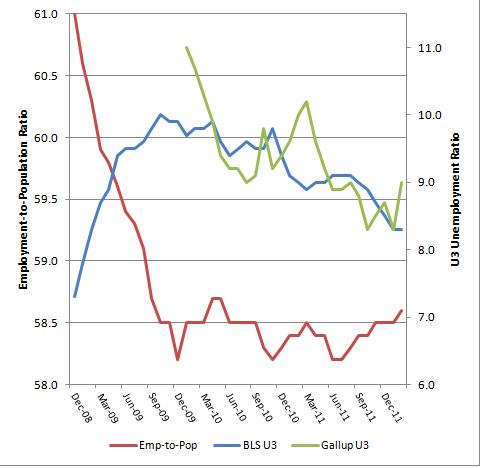
If we dig into the report beyond the headline numbers, we won’t like what we find. First, let’s explore why the unemployment rate declined, even though employment declined. How can that happen, you ask? It happens because the denominator declined by more than the  numerator (remember that lesson on fractions from grammar school?). In fact, employment as reported by the Household Survey, which queries households rather than employers, declined by not 125,000 but by  301,000. This number is far in excess of the decline in Census employment, indicating that total private sector employment declined by more than 50,000 workers. The Household Survey includes self-employed workers and workers hired by recently established businesses that are missed by the Establishment Survey, so this discrepancy is especially disturbing.

Even more disturbing is what happened to the size of the civilian labor force, which is the denominator of the unemployment rate. That number declined by a stunning 842,000 workers. This reflects the 301,000 workers who reported that they became unemployed during June, 350,000 unemployed workers who gave up looking for jobs during June, and a 191,000 increase in the size of the civilian non-institutional population. The 191,000 number is how many jobs the U.S. needs to create just to “break even” when we lose no jobs and no one leaves the labor force.

An informative exercise is to calculate what the unemployment rate would have been had the 651,000 employed and unemployed who left the labor force remained in the labor force by looking for work during the past four weeks: the unemployment rate would have risen by 0.2 to 9.9% rather than declining by 0.2 to 9.5%.

The ranks of the chronic unemployed—those out of work for at least 26 weeks—was virtually unchanged at 6.75 million, or almost half of the 14,623 unemployed. The median duration of unemployment rose to 25.5 weeks in June from 23.2 weeks in May.