<?xml version="1.0" encoding="utf-8"?>
<feed xmlns="http://www.w3.org/2005/Atom">
    <title>Professor Cole&apos;s Finance Blog</title>
    <link rel="alternate" type="text/html" href="http://krahenbuhlglobal.com/blog/" />
    <link rel="self" type="application/atom+xml" href="http://krahenbuhlglobal.com/blog/atom.xml" />
   <id>tag:krahenbuhlglobal.com,2012:/blog/1</id>
    <link rel="service.post" type="application/atom+xml" href="http://www.krahenbuhlglobal.com/blog-mt/mt-atom.cgi/weblog/blog_id=1" title="Professor Cole's Finance Blog" />
    <updated>2012-03-10T18:10:52Z</updated>
    
    <generator uri="http://www.sixapart.com/movabletype/">Movable Type 3.2ysb5-20051201</generator>
 
<entry>
    <title>Thoughts on the Feb. Employment Report</title>
    <link rel="alternate" type="text/html" href="http://krahenbuhlglobal.com/blog/2012/03/thoughts_on_the_feb_employment.html" />
    <link rel="service.edit" type="application/atom+xml" href="http://www.krahenbuhlglobal.com/blog-mt/mt-atom.cgi/weblog/blog_id=1/entry_id=87" title="Thoughts on the Feb. Employment Report" />
    <id>tag:krahenbuhlglobal.com,2012:/blog//1.87</id>
    
    <published>2012-03-10T18:02:37Z</published>
    <updated>2012-03-10T18:10:52Z</updated>
    
    <summary><![CDATA[Yesterday, the Bureau of Labor Statistics release its employment report for Feb. 2012. The headline jobs number of +227,000 was hailed by many as more evidence that the U.S. labor market is healing, or even, &quot;strong.&quot; In addition, the January...]]></summary>
    <author>
        <name>m1rac01</name>
        
    </author>
    
    <content type="html" xml:lang="en" xml:base="http://krahenbuhlglobal.com/blog/">
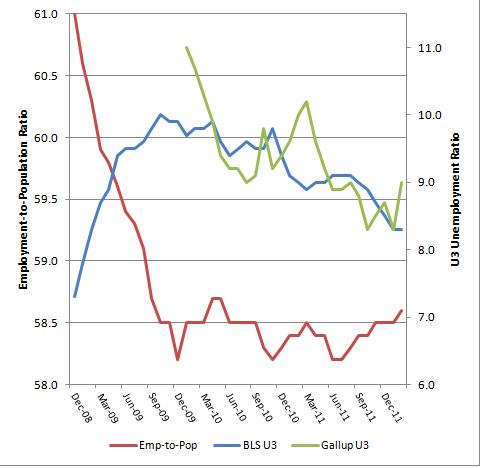
        <![CDATA[<p>Yesterday, the Bureau of Labor Statistics release its employment report for Feb. 2012. The headline jobs number of +227,000 was hailed by many as more evidence that the U.S. labor market is healing, or even, &quot;strong.&quot; In addition, the January number was revised upwards by 41,000 to 284,000 and the December number was revised upwards by 20,000 to 223,000.</p><p>Yet the unemployment rate was unchanged at 8.3%, breaking five months of improvement, as almost half a million workers joined (or more likely, rejoined) the labor force.</p><p>&nbsp;</p><p><img width="480" height="468" alt="UE_2012_Feb.jpg" src="http://krahenbuhlglobal.com/blog/UE_2012_Feb.jpg" border="0" /></p><p>My preferred measure of labor-market health, the employment-to-population ratio, edged upwards to 58.6% from 58.5%, which is encouraging, but remains stuck in a range it has not exceeded since August 2009. So don't break out the champaign just yet.</p><p>Moreover, the BLS numbers are at odds with another highly respected survey, one done by the Gallup organization. Gallup, which does not seasonally adjust, reported that the unemployment rate jumped from 8.3% in January to 9.0% in February. While much of this discrepancy may be due to seasonal factors, especially given the unseasonably warm February weather, it may be that the Gallup number has caught a trend that the preliminary BLS number has missed. We will have to wait another month to find out exactly what is really going on in the U.S. labor market.</p>]]>
        
    </content>
</entry>
<entry>
    <title>Obama&apos;s Failed Housing Policies: Housing Prices Continue to Fall</title>
    <link rel="alternate" type="text/html" href="http://krahenbuhlglobal.com/blog/2012/01/obamas_failed_housing_policies.html" />
    <link rel="service.edit" type="application/atom+xml" href="http://www.krahenbuhlglobal.com/blog-mt/mt-atom.cgi/weblog/blog_id=1/entry_id=86" title="Obama's Failed Housing Policies: Housing Prices Continue to Fall" />
    <id>tag:krahenbuhlglobal.com,2012:/blog//1.86</id>
    
    <published>2012-01-31T17:58:34Z</published>
    <updated>2012-01-31T17:59:03Z</updated>
    
    <summary><![CDATA[ Today, S&amp;P released the Case-Shiller housing price indices for November 2011; the headline numbers were month-over-month decline of 0.7% and year-over-year decline of 3.7%. Here in Chicago, the news was much worse: down 3.4% month-over-month and down 5.9% year-over-year....]]></summary>
    <author>
        <name>m1rac01</name>
        
    </author>
    
    <content type="html" xml:lang="en" xml:base="http://krahenbuhlglobal.com/blog/">
        <![CDATA[  <p class="MsoNormal" style="margin: 0in 0in 10pt">Today, S&amp;P released the <a href="http://www.standardandpoors.com/spf/docs/case-shiller/CSHomePrice_Release_013118.pdf">Case-Shiller housing price indices for November 2011</a>; the headline numbers were month-over-month decline of 0.7% and year-over-year decline of 3.7%. Here in Chicago, the news was much worse: down 3.4% month-over-month and down 5.9% year-over-year. </p>  <p class="MsoNormal" style="margin: 0in 0in 10pt">Housing prices are now back to mid-2003 values, meaning that anyone who has bought a house during the past nine years has lost money, and the vast majority are now &ldquo;underwater,&rdquo; owing more on their mortgage than their house is worth. We are now less than 1% away from the post-crisis low of 2009, and heading further downward. </p>  <p class="MsoNormal" style="margin: 0in 0in 10pt">There can be no more of a damning indictment of the Obama administration&rsquo;s failed housing policies (HAMP, HARP, HAMP2, HARP2, etc. and now the proposed Robo-Signing Settlement); except, of course, for the <a href="http://www.lpsvcs.com/LPSCorporateInformation/NewsRoom/Pages/20120119.aspx">2.1 million homeowners currently in the process of foreclosure</a>, the 1.8 million homeowners who are seriously delinquent on their mortgages, and the estimated<a href="http://www.calculatedriskblog.com/2011/12/lawler-completed-foreclosure-sales-in.htmlhttp:/www.calculatedriskblog.com/2011/12/lawler-completed-foreclosure-sales-in.html"> 3 million former homeowners who have lost their houses to foreclosure since Jan. 2009</a>.</p>  <p class="MsoNormal" style="margin: 0in 0in 10pt">The government came to the aid of the Wall Street bankers with the <a href="http://en.wikipedia.org/wiki/Troubled_Asset_Relief_Program">$700 billion TARP</a> and the <a href="http://www.bloomberg.com/news/2011-12-23/fed-s-once-secret-data-compiled-by-bloomberg-released-to-public.htmlhttp:/www.bloomberg.com/news/2011-12-23/fed-s-once-secret-data-compiled-by-bloomberg-released-to-public.html">$7.7 trillion in Fed loans</a>; is it really asking too much for the government to come to the aid of homeowners with a <a href="http://papers.ssrn.com/sol3/papers.cfm?abstract_id=1338883">viable restructuring program</a> that would stanch the economic hemorrhaging from foreclosures. This would require a program similar in magnitude to the TARP, but one that could be structured so that participating homeowners would pay back the government&rsquo;s investment through shared future appreciation of their properties. Instead, the administration continues to look for yet more ways to funnel even more government aid to the Wall Street bankers, while Main Street borrowers struggle to hang on to their homes.</p>  ]]>
        
    </content>
</entry>
<entry>
    <title>Why the Proposed Robo-Signing Settlement is a Bad Idea</title>
    <link rel="alternate" type="text/html" href="http://krahenbuhlglobal.com/blog/2012/01/why_the_proposed_robosigning_s_1.html" />
    <link rel="service.edit" type="application/atom+xml" href="http://www.krahenbuhlglobal.com/blog-mt/mt-atom.cgi/weblog/blog_id=1/entry_id=85" title="Why the Proposed Robo-Signing Settlement is a Bad Idea" />
    <id>tag:krahenbuhlglobal.com,2012:/blog//1.85</id>
    
    <published>2012-01-29T18:52:26Z</published>
    <updated>2012-01-29T18:52:36Z</updated>
    
    <summary><![CDATA[ On Jan. 23rd, HUD Secretary Shaun Donovan met in Chicago with several Democratic state Attorneys General in an attempt to strong-arm them into signing on to an Administration-backed agreement to settle the so-called &ldquo;robo-signing&rdquo; scandal. &nbsp;The Wall Street banks...]]></summary>
    <author>
        <name>m1rac01</name>
        
    </author>
    
    <content type="html" xml:lang="en" xml:base="http://krahenbuhlglobal.com/blog/">
        <![CDATA[  <p class="MsoNormal"><span>On Jan. 23<sup>rd</sup>, HUD Secretary Shaun Donovan met in Chicago with several Democratic state Attorneys General in an attempt to strong-arm them into signing on to an Administration-backed agreement to settle the so-called &ldquo;robo-signing&rdquo; scandal. <span>&nbsp;</span>The Wall Street banks would pay what sounds like a large fine ($25 billion), and, in exchange, the state AGs would relieve the bankers of all legal liabilities related to the fraudulent mortgage lending practices that directly led to the 2008 financial meltdown and a 30 percent drop in U.S. home prices. <br /></span></p>  <p class="MsoNormal"><span>Sadly, this is nothing more than another bail-out of the Wall Street banks, in addition to the $700 billion Troubled Asset Relief Program (&ldquo;TARP&rdquo;), the $7 trillion in loans to the banks from the Federal Reserve, and the Fed&rsquo;s zero-interest rate policy, which has allowed banks to borrow from the Fed at zero while investing in U.S. Treasury bonds at four percent. The fraudulent practices of the mortgage servicers have injected an untold number of forged documents into the legal system, jeopardizing the clean titles to millions of homes around the country. The costs of cleaning up this legal mess will most likely be in the hundreds of billions of dollars, yet this settlement would let the Wall Street settle up with the state AGs for only $25 billion. Worse yet, most of this money would actually come from the pockets of investors who now own the mortgages in the form of mortgage-backed secuities, not from the perpetrators of fraud, and the rest would come out of the pockets of bank shareholders, rather than from the miscreants who perpetrated the fraud.<br /></span></p>  <p class="MsoNormal"><span>When a homeowner defaults on his mortgage, let us all agree that someone has the right to foreclose. The question is whom? In order to protect peasants from expropriation of their land by nobles, English Common Law, back in 1677, established the Statute of Frauds, which requires that all legal contracts involving land be in writing with &ldquo;wet signatures.&rdquo; Real property law in most states follows the Statute of Frauds in setting forth legal requirements for a lender to establish before the court that it has the legal right to foreclose and take the property of a borrower. <br /></span></p>  <p class="MsoNormal"><span>Herein lies the problem. In its rush to securitize poorly underwritten mortgages and foist them upon unsuspecting investors around the world, the Wall Street bankers decided that they did not have to play by the (legal) rules. They did not create and/or keep the original documents needed to prove to the property courts that a lender has the legal right to foreclose. The bankers didn&rsquo;t care&mdash;because they no longer owned the mortgages; they only serviced the mortgages for investors to whom they had sold the mortgage-backed securities (&ldquo;MBS&rdquo;).<br /></span></p>  <p class="MsoNormal"><span>&ldquo;No-doc&rdquo; loans became &ldquo;no-doc&rdquo; foreclosures because servicers found it much cheaper to foreclose with forged documents than to restructure a mortgage, even when the restructuring is in the best interests of the investor who owns the mortgage. Losses on foreclosed properties go to the investors; the bank servicers get paid no matter how severe the losses.<br /></span></p>  <p class="MsoNormal"><span>When a few borrowers challenged &ldquo;no-doc&rdquo; foreclosures, the bankers responded by &ldquo;re-creating&rdquo; the originals&mdash;i.e., by forging and backdating signatures and notarizations; and then by committing perjury about their actions before the property courts.<span>&nbsp; </span>Borrowers (and the media) responded, in turn, by calling attention to the &ldquo;perjury&rdquo; and &ldquo;forgery&rdquo; problems that Wall Street prefers to peddle as &ldquo;paperwork&rdquo; problems.<br /></span></p>  <p class="MsoNormal"><span>Why does this matter so much? Because of what economists call &ldquo;externalities;&rdquo; what happens to the homeowner who is going into foreclosure affects each and every one of us. If there is one foreclosure in your neighborhood, the value of your house will fall by one percent; if there are five foreclosures in your neighborhood, the value of your house will fall not by five percent but by ten percent; and if there are ten foreclosures in your neighborhood, you might not be able sell your house at any price. Why? <br /></span></p>  <p class="MsoNormal"><span>When a delinquent homeowner vacates a house, it is more often than not, immediately vandalized by criminals who steal anything that can be sold for value, such as aluminum siding, copper pipes, and appliances such as heat pumps. This makes it impossible for the lender to sell the foreclosed house without investing tens of thousands in repairs, which they often are unwilling to do. Hence, the property becomes a haven for criminals in search of a private place to do their business.<br /></span></p>  <p class="MsoNormal"><span>Therefore, it is critically important that the state AGs, and property courts around the country, maintain the Rule of Law. If a bank has the legal right to foreclose, then it must follow the law by producing in court the legal documents required to back its claim. If the bank cannot produce these documents, then it must take the expensive legal steps to re-establish its legal rights; it cannot be allowed to simply forge copies of the original documents that it failed to maintain. Such forgeries have clouded the titles to the almost ten-million foreclosed properties seized since 2007, and will cloud the titles to the four-million properties that currently are headed into foreclosure. The costs of cleaning up the millions of titles to foreclosed homes, by themselves, will far exceed the proposed $25 billion settlement&mdash;by as much as an order of magnitude.<br /></span></p>  <p class="MsoNormal"><span>Instead of giving a free pass to the Wall Street banker who created the housing crisis, the state AGs should instead prosecute every instance of fraud, forgery and perjury within their jurisdiction. Flip the little fish into testifying against the big fish; then hit the big fish with jail time. Don&rsquo;t leave bank shareholders holding the bag for the criminality of the Wall Street bankers who created the financial crisis. Now is the time for accountability, not for another big-bank bailout. </span></p><p class="MsoNormal"><span>Note: An edited version of this entry appeared as an <a title="Op-Ed" href="http://www.washingtontimes.com/news/2012/jan/27/obamas-next-bailout/">Op-Ed</a> in The Washington Times on Monday, Jan. 30, 2012.<br /></span></p>&nbsp; ]]>
        
    </content>
</entry>
<entry>
    <title>Thoughts on the December Jobs Report</title>
    <link rel="alternate" type="text/html" href="http://krahenbuhlglobal.com/blog/2012/01/thoughts_on_the_december_jobs.html" />
    <link rel="service.edit" type="application/atom+xml" href="http://www.krahenbuhlglobal.com/blog-mt/mt-atom.cgi/weblog/blog_id=1/entry_id=83" title="Thoughts on the December Jobs Report" />
    <id>tag:krahenbuhlglobal.com,2012:/blog//1.83</id>
    
    <published>2012-01-29T18:42:26Z</published>
    <updated>2012-01-29T18:44:12Z</updated>
    
    <summary><![CDATA[On Friday, the Bureau of Labor Statistics (BLS) released the jobs report, more formally known as &ldquo;The Employment Situation,&rdquo; for December 2011. The headline numbers were 200,000 new jobs and a decline in the unemployment rate to 8.5% from 8.6%...]]></summary>
    <author>
        <name>m1rac01</name>
        
    </author>
    
    <content type="html" xml:lang="en" xml:base="http://krahenbuhlglobal.com/blog/">
        <![CDATA[<p>On Friday, the Bureau of Labor Statistics (BLS) released the jobs report, more  formally known as &ldquo;The Employment Situation,&rdquo; for December 2011. The  headline numbers were 200,000 new jobs and a decline in the unemployment rate  to 8.5% from 8.6% in November.</p><p>Now, the trend for each headline number is clearly in the right directly: more jobs  and fewer unemployed. However, when we look more closely at the report, there  are a lot of causes for continuing worry about the health of the U.S. labor market.</p><p>First, and most importantly, the size of the labor force continued to decline, down  50,000 workers, even though the population of potential workers rose by 143,000. This caused the number of potential workers &ldquo;not in the labor force&rdquo; to rise by 194,000, which is almost equal to the 226,000 decline in the number of unemployed workers. In other words, more and more Americans are simply giving up on trying to even find a job. Until we see the size of the labor force rising on a consistent basis, we will know that the labor market is still is trouble.</p><p>Second, 42,200 of the new jobs in December were for &ldquo;Couriers and Messengers,&rdquo; as online shopping continued to grow, creating temporary demand for these workers to deliver Christmas presents. This same phenomenon was observed during December in both 2009 and 2010, and was followed by an almost equal decline in the number of &ldquo;courier and messenger&rdquo; jobs during January. Look for a loss of more than 40,000 &ldquo;courier and messenger jobs during January 2012, as well.</p><p>Third, 27,900 of the new jobs were in &ldquo;Retail Trade,&rdquo; with 13,000 in general merchandise stores, 11,100 in clothing stores, and 8,200 in &ldquo;food and beverage&rdquo; stores. Were these also temporary Christmas jobs? It certainly seems likely. January&rsquo;s jobs report will let us know for  sure. In any case, these certainly are not the sort of high-paying jobs on which one can raise a family; more likely, these are minimum-wage, or slightly above, jobs.</p><p>Fourth, 22,600 new jobs were in &ldquo;Health Care.&rdquo; While these could be doctors, nurses and  administrators, it is more likely that they are low-paying, and temporary, positions as nurses assistants and home care workers.  Still, a bad job is better than no job.</p><p>For all of these reasons, we should not consider the U.S. jobs market to really be on  the mend and out of the woods, but at least the trend is in our favor.</p>]]>
        
    </content>
</entry>
<entry>
    <title>How To Fix America&apos;s Broken Banking System</title>
    <link rel="alternate" type="text/html" href="http://krahenbuhlglobal.com/blog/2011/09/americas_broken_banking_system.html" />
    <link rel="service.edit" type="application/atom+xml" href="http://www.krahenbuhlglobal.com/blog-mt/mt-atom.cgi/weblog/blog_id=1/entry_id=82" title="How To Fix America's Broken Banking System" />
    <id>tag:krahenbuhlglobal.com,2011:/blog//1.82</id>
    
    <published>2011-09-21T16:49:36Z</published>
    <updated>2011-09-22T00:13:04Z</updated>
    
    <summary><![CDATA[Last week, Bank of America CEO Brian Moynihan announced that he had decided to give up the distinction of being the largest banking company in America by reducing the firm&rsquo;s size from $2.3 trillion to $1.7 trillion in assets. What...]]></summary>
    <author>
        <name>m1rac01</name>
        
    </author>
    
    <content type="html" xml:lang="en" xml:base="http://krahenbuhlglobal.com/blog/">
        <![CDATA[<p>Last week, Bank of America CEO Brian Moynihan announced that he had decided to give up the distinction of being<a title="the largest bank in America" href="http://www.businessweek.com/news/2011-09-12/bofa-to-cede-top-rank-as-moynihan-disowns-bigger-is-better.html" target="_blank"> the largest banking company in America</a> by reducing the firm&rsquo;s size from $2.3 trillion to $1.7 trillion in assets. What makes this story so amazing is that Moynihan&rsquo;s two predecessors, Ken Lewis and Hugh McColl, had spent the past two decades growing what was then known as Nationsbank (and even earlier as North Carolina National Bank) from a southern regional bank into the title of America&rsquo;s largest bank. </p><p>McColl and Lewis, however, were not alone. The CEOs of most large banks had pursued the same title over the past 20 years. In 1991, the largest banking company in the U.S. was Citicorp, with about $220 billion in assets; today it is Bank of America, with about $2.5 <em>trillion</em> in assets. This pursuit of size also has resulted in an industry dominated by four trillion-dollar firms: BofA, Citi, JPMorgan Chase and Wells Fargo. Together, these four companies control about half of the industry&rsquo;s assets, whereas twenty years ago, the four largest banks controlled less than ten percent of industry assets. Today there are about 7,000 banks; in 1991, there were almost twice that number. Most of the difference is the result of mergers, as the biggest banks gobbled up their smaller rivals and increased their size by an order of magnitude.</p><p>This raises two related questions: Why do banking CEOs prize size so highly; and why is Moynihan taking BofA in the other direction? The answer to the first question requires us to examine the governance structure of the modern American corporation; the answer to the second requires us to see what makes BofA different from its competitors.</p><p>In corporate America, a company&rsquo;s leader is its CEO. The CEO, after consulting her <a title="board of directors" href="http://en.wikipedia.org/wiki/Board_of_directors" target="_blank">board of directors,</a> makes the most important strategic decisions, such as in which assets to invest and how to finance those assets. The board of directors, whose members are elected by and represent the company&rsquo;s shareholders, have the job of hiring, compensating, monitoring, and, if necessary, firing the CEO. </p><p>Many observers of corporate America, including this professor, would argue that this system of governance is broken, in that the board of directors has been co-opted by the CEO, who typically also serves as the Chairman of the Board of Directors, a position that enables her to set the agenda of board meetings. The CEO also often chairs the board&rsquo;s nominating committee, which selects prospective new board members. In conjunction with her management team, known as &ldquo;inside&rdquo; board members, the CEO typically has more votes than independent, or &ldquo;outside,&rdquo; board members. Hence, the CEO is able to control the board rather than the board controlling the CEO. This includes such critical duties as setting compensation, which provides the CEO with incentives to invest in certain assets and finance those investments with certain types of funds.</p><p>What has happened in most industries, including banking, is that <a title="boards have turned to consultants" href="http://knowledge.wharton.upenn.edu/article.cfm?articleid=1481" target="_blank">boards have turned to consultants</a> for guidance on setting compensation. Those consultants typically recommend tying a CEO&rsquo;s compensation to what is paid by other companies in the same industry and of comparable size, where size is typically measured by annual revenues. Hence, we see CEOs pursuing growth of revenues above all else and often without regard to levels of risk. </p><p>A national franchise also means national political clout. Bank of America has branches in almost every Congressional district, giving it access to virtually every single member of the U.S. Congress.</p><p>In banking, there is yet a third reason to grow so large. When the solvency of a bank threatens the entire financial system, it is said to be &ldquo;<a title="too-big-to-fail" href="http://en.wikipedia.org/wiki/Too_big_to_fail" target="_blank">too big to fail</a>,&rdquo; or TBTF. Once a bank becomes TBTF, it can pursue reckless high-risk investment strategies, knowing that it can privatize any gains, but will be able to socialize the losses through a taxpayer bailout. This is exactly what happened back in 2008 when Treasury Secretary Hank Paulson asked for $800 billion to bail out the TBTF banks.</p><p>So what makes BofA different from its competitors, who continue to grow? The answer can be summarized in one word: <a title="Countrywide" href="http://en.wikipedia.org/wiki/Countrywide_Financial">Countrywide</a>. In his quest for the title of the &ldquo;biggest,&rdquo; Ken Lewis entered into what will most probably be known as the most disastrous acquisition in the history of corporate America. Countrywide was ground zero of the subprime-mortgage debacle, lending more than a trillion dollars to just about anyone with a pulse, and then selling most (but not all) of these mortgages to investors with promises that they were triple-A investments. We now know that these promises were false; a huge percentage of these mortgages have gone into default, resulting in tens, if not hundreds, of billions in losses. BofA inherited most of its bad loans from Countrywide and most of the investors now suing BofA for fraud suffered losses from mortgages originated by Countrywide.</p><p>While not much can be done to save BofA, we can make changes to reduce the likelihood of another financial meltdown like 2008. The first of these reforms would be to limit banking companies to banking activities, forcing them to divest their investment banking activities. This was a depression-era reform known as the <a title="Glass-Steagall Act" href="http://en.wikipedia.org/wiki/Glass%E2%80%93Steagall_Act" target="_blank">Glass-Steagall Act</a>, one that was abandoned during the late 1990s. This reform alone would cut the size of the largest banks by almost half. That said, half of 2 trillion is still too big. The only way to eliminate TBTF is to limit the size of banks. There is no reason why banks need to be larger than was Citicorp back in 1991 at $220 billion; such a limit is eminently reasonable and would limit future taxpayer losses.</p><p>The second of these reforms would be a series of changes to corporate governance. To limit the ability of the CEO to co-opt her Board of Directors, we should prohibit a CEO from simultaneously serving as Chairman of the Board; and from simultaneously chairing any board committee, especially the nominating committee. To limit the aggregate board control of insiders, we should require that a majority of all boards be composed of so-called &ldquo;outside&rdquo; directors, i.e., directors who don&rsquo;t also serve as members of the management teams. Finally, tying CEO compensation more closely to long-term performance, especially long-run stock returns, instead of to annual revenues, would reduce incentives for pursuing high-risk investments.</p><p>With these two sets of reforms, we could fundamentally change the governance of U.S. corporations in ways that reduce the separation of ownership from control, restoring control to the shareholders that actually &ldquo;own&rdquo; the firm; and limit the potential taxpayer liabilities from the next financial crisis, which, under the current system, always seems to be just around the corner.</p><p>NOTE: An edited version of this blog appeared Sep. 20 in the Washington Post's new &quot;<a title="OnLeadership" href="http://www.washingtonpost.com/national/on-leadership/creating-better-banks-of-america/2011/09/20/gIQAYlVriK_story.html">OnLeadership</a>&quot; blog.</p>]]>
        
    </content>
</entry>
<entry>
    <title>20% Unemployment . . . in the United States?!!!</title>
    <link rel="alternate" type="text/html" href="http://krahenbuhlglobal.com/blog/2011/09/20_unemployment_in_the_united.html" />
    <link rel="service.edit" type="application/atom+xml" href="http://www.krahenbuhlglobal.com/blog-mt/mt-atom.cgi/weblog/blog_id=1/entry_id=81" title="20% Unemployment . . . in the United States?!!!" />
    <id>tag:krahenbuhlglobal.com,2011:/blog//1.81</id>
    
    <published>2011-09-03T20:07:46Z</published>
    <updated>2011-09-04T03:12:43Z</updated>
    
    <summary> Yesterday, the Bureau of Labor Statistics released its monthly employment report for August. The surprising headline number was zero, as is zero new payroll jobs. Not positive. Not negative. Exactly zero. Difficult to believe, eh? No worries: the BLS...</summary>
    <author>
        <name>m1rac01</name>
        
    </author>
    
    <content type="html" xml:lang="en" xml:base="http://krahenbuhlglobal.com/blog/">
        <![CDATA[  <p class="MsoNormal" style="margin: 0in 0in 10pt">Yesterday, the Bureau of Labor Statistics released its monthly employment report for August. The surprising headline number was zero, as is zero new payroll jobs. Not positive. Not negative. Exactly zero. Difficult to believe, eh? No worries: the BLS revised downward the reported payroll jobs numbers for June and July by about 50,000, so next month, expect the August number to be revised into a negative loss in the tens of thousands. Thus, a &ldquo;double-dip&rdquo; recession almost surely begins, as we already have seen quarterly GDP growth slowing to almost zero, and also seeing downward revisions each month. </p>  <p class="MsoNormal" style="margin: 0in 0in 10pt">As if this isn&rsquo;t bad enough, looking deeper at the BS in the BLS numbers, we find that BLS staff included in the Aug. payroll numbers 87,000 workers &ldquo;invented&rdquo; by the BLS &ldquo;birth-death&rdquo; model, which is designed to account for job changes at firms not covered by the establishment survey. Thus far this year, the &ldquo;birth-death&rdquo; model has added 800,000 &ldquo;new jobs&rdquo; to the payroll statistics that almost certainly don&rsquo;t really exist. During each of the past three years, the BLS had had to &ldquo;walk back&rdquo; these monthly estimates in January, when it benchmarks the establishment data with actual unemployment insurance records. Of course, it doesn&rsquo;t consider these as &ldquo;lost&rdquo; jobs, nor does it go back and revise the monthly numbers. So don&rsquo;t put too much credence in the meager employment &ldquo;growth&rdquo; reported since 2009; it&rsquo;s all smoke and mirrors, or, as I like to say, BLS &ldquo;BS&rdquo;.</p>  <p class="MsoNormal" style="margin: 0in 0in 10pt">More bad news is found in Table A-8 of the BLS report, which provides details on part-time vs. full-time employment. The number of workers working part time for economic reasons, i.e., who wanted a full-time job but couldn&rsquo;t find one, rose by a staggering 430,000. In other words, we actually lost 430,000 full-time jobs, which were replaced by part-time jobs, in order to keep the aggregate payroll number at &ldquo;zero.&rdquo; </p>  <p class="MsoNormal" style="margin: 0in 0in 10pt">From the household survey, we actually got some positive news: employment increased by 331,000 as 165,000 discouraged workers came back into the labor force and, with population growth, the labor force increased by 366,000. Many economists, including me, think that the household survey gives a better idea of when the jobs market changes direction, so this is indeed a &ldquo;green shoot&rdquo; in an otherwise very brown landscape.</p>  <p class="MsoNormal" style="margin: 0in 0in 10pt">The unemployment rate remained unchanged at 9.1% as measured by the U-3 metric, which only includes workers who actively looked for a new job during the previous four weeks. The broader U-6 measure, which includes discouraged workers and part-timers who wanted full-time work, rose from 16.1% to 16.2%. If we add in the 6 million discouraged workers that the BLS does not consider part of the labor force, we arrive at a unemployment rate of more than 20%; in other words, one in five U.S. workers who wants a full-time job can&rsquo;t find one. </p>&nbsp; ]]>
        
    </content>
</entry>
<entry>
    <title>A &quot;Free Lunch&quot; for Small Business</title>
    <link rel="alternate" type="text/html" href="http://krahenbuhlglobal.com/blog/2011/08/a_free_lunch_for_small_busines.html" />
    <link rel="service.edit" type="application/atom+xml" href="http://www.krahenbuhlglobal.com/blog-mt/mt-atom.cgi/weblog/blog_id=1/entry_id=80" title="A &quot;Free Lunch&quot; for Small Business" />
    <id>tag:krahenbuhlglobal.com,2011:/blog//1.80</id>
    
    <published>2011-08-26T21:26:54Z</published>
    <updated>2011-08-27T04:28:34Z</updated>
    
    <summary>With more than 14 million unemployed American workers and an unemployment rate stubbornly above 9 percent, perhaps the most vexing economic issue of our day is how to create new jobs.If we can put these Americans back to work, they...</summary>
    <author>
        <name>m1rac01</name>
        
    </author>
    
    <content type="html" xml:lang="en" xml:base="http://krahenbuhlglobal.com/blog/">
        <![CDATA[<p>With more than 14 million unemployed American workers and an unemployment rate stubbornly above 9 percent, perhaps the most vexing economic issue of our day is how to create new jobs.</p><p>If we can put these Americans back to work, they will once again be paying taxes instead of collecting unemployment benefits, which will largely take care of our budget-deficit problem. But how can we create new jobs without spending additional hundreds of billions of dollars, on top of the $787 billion spent on the Obama administration&rsquo;s 2009 stimulus plan, which has failed so spectacularly? What if I told you that there is a &ldquo;free lunch&rdquo; with respect to job creation, if only we were to change some simple, yet onerous, employment regulations on small businesses?</p><p>I am a small-business owner, but I am also a pointy-headed academic - a professor of finance - who has studied small businesses for almost two decades, so I have a unique perspective on how to create new jobs. My small business needs to hire its first employee. Why is this important? Because new research indicates that almost all new jobs are created by young and small businesses hiring their first employees. That said, I will not be hiring my first employee. Why? Because it is just too expensive. Let&rsquo;s look at the costs and benefits.</p><p>If I am to pay my new employee $20 per hour, or $40,000 per year, how much will it actually cost me to hire this worker? Let&rsquo;s assume my pay is $125 per hour, or $250,000 per year, which puts me into the bottom of President Obama&rsquo;s &ldquo;millionaires and billionaires&rdquo; earnings bracket that includes so many entrepreneurs. Each quarter, I will have to file <a href="http://www.krahenbuhlglobal.com/topics/internal-revenue-service/">IRS</a> Form 941 - Employer&rsquo;s Quarterly Federal Tax Return. The government estimates it will take me 15.7 hours in recordkeeping and preparing the form each quarter, for a total of 63 hours per year. Each year, I also will have to file <a href="http://www.krahenbuhlglobal.com/topics/internal-revenue-service/">IRS</a> Form 940 - Employer&rsquo;s Annual Federal Unemployment Tax Return. The government estimates that it will take me 12 hours in recordkeeping and preparing the form each year. At my assumed $125 hourly rate of pay, just these five forms will cost me 75 hours at $125 per hour for a total cost of $9,375 per year.</p><p>I also will have to pay half of my employee&rsquo;s Social Security and <a href="http://www.krahenbuhlglobal.com/topics/medicare/">Medicare</a> taxes, or another $3,000 plus unemployment tax equal to 6 percent of the first $7,000 in wages, or $420. So, to pay my employee $40,000, it will cost me $43,420 out of pocket, plus an opportunity cost of $9,375, for a total of $52,795, or 32 percent more than the $40,000 I had hoped to pay my first employee. Moreover, there are serious monetary penalties should I miscalculate the withholding taxes, not to mention the additional time required to file amended forms. And there are undoubtedly other regulatory-compliance costs that I have overlooked. Now I decide that I will not hire a new employee.</p><p>What if we change the rules of the game for the smallest of small businesses? What if we allow small businesses to hire their first one (or two or three) employees as independent contractors, doing away with all of these regulatory burdens? (Currently, this would violate Federal and state employment laws.) The huge fixed costs of hiring a first employee disappear immediately. According to the U.S. Census Bureau, there are more than 20 million zero-employee firms in the United States with almost a trillion dollars in annual sales. If only a fraction of these firms decide to hire their first employee, this could be a game-changer, boosting employment by millions.</p><p>What is the downside? Zero. This can be a revenue-neutral deal. My employee would still pay Social Security and <a href="http://www.krahenbuhlglobal.com/topics/medicare/">Medicare</a> taxes but as an independent contractor, he would be responsible for the full 15 percent rather than only the half that salaried employees pay. I would be willing to pay the employee an additional 7.5 percent to cover these taxes; I would be paying that amount anyway under current rules. The big savings come from the elimination of the reporting burden that frees me up to do productive work for my clients, rather than do unproductive paperwork for Uncle Sam.</p><p>NOTE: This entry appeared as an op-ed in the Aug. 26, 2011 edition of the Washington Times.</p><p>Available online at: <a href="http://t.co/kGh88Sv">http://t.co/kGh88Sv</a> &nbsp;</p>]]>
        
    </content>
</entry>
<entry>
    <title>Deja Vu: 2008 All Over Again?</title>
    <link rel="alternate" type="text/html" href="http://krahenbuhlglobal.com/blog/2011/08/deja_vu_2008_all_over_again.html" />
    <link rel="service.edit" type="application/atom+xml" href="http://www.krahenbuhlglobal.com/blog-mt/mt-atom.cgi/weblog/blog_id=1/entry_id=79" title="Deja Vu: 2008 All Over Again?" />
    <id>tag:krahenbuhlglobal.com,2011:/blog//1.79</id>
    
    <published>2011-08-20T18:39:10Z</published>
    <updated>2011-08-21T06:23:22Z</updated>
    
    <summary>After a five-trading-day respite, the Dow-Jones Industrials returned to a 500-point intraday price swing on Thursday, ending down almost 420 points; on Friday, the volatility was lower but the market lost another 170 points to finish at 10,817, a loss...</summary>
    <author>
        <name>m1rac01</name>
        
    </author>
    
    <content type="html" xml:lang="en" xml:base="http://krahenbuhlglobal.com/blog/">
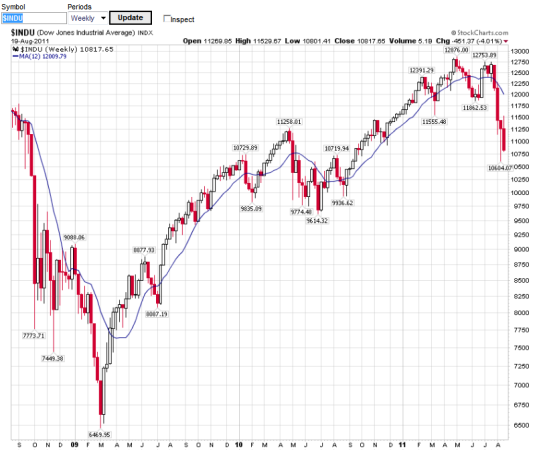
        <![CDATA[<p class="MsoNormal"><span>After a five-trading-day respite, the Dow-Jones Industrials returned to a 500-point intraday price swing on Thursday, ending down almost 420 points; on Friday, the volatility was lower but the market lost another 170 points to finish at 10,817, a loss of 4% for the week and 15% from the May high. Similar changes were seen in the broader indices, such as the S&amp;P500, which finished at 1,124, down 5% for the week and 16% from the May high. What is responsible for this collapse in the stock market? Was it those pesky tea-partiers, who &ldquo;held the government hostage&rdquo; while demanding serious action on reducing the ever-ballooning national debt? That is what you will hear from pundits on the left. </span></p><p class="MsoNormal"><span><img border="0" alt="Dow_Weekly_Candlestick_2011_Aug_s.png" src="http://krahenbuhlglobal.com/blog/Dow_Weekly_Candlestick_2011_Aug_s.png" width="535" height="455" /></span></p><p class="MsoNormal"><span>In reality, it is just an end to the &ldquo;irrational exuberance&rdquo; that took the stock market up more than 25% from last summer. What was the reason for this bubble? Apparently, investors were betting on an economic recovery in the U.S. Unfortunately for us all, they have been disappointed by a reality check. </span></p><p class="MsoNormal"><span>Unemployment remains stubbornly above 9%. <a title="Bureau of Labor Statistics reports" href="http://www.bls.gov/news.release/pdf/empsit.pdf">As of July 2011, the Bureau of Labor Statistics reported</a> that only 140.38 million Americans were working, which was only 204,000 more than July 2010, even though the U.S. population had increased by 1.8 million. The unemployment rate would be even worse had not almost a half-million workers given up and left the labor force. Clearly, the labor market is no healthier today than it was a year ago; in fact, it is worse and likely to deteriorate further as recently announced corporate layoffs take place in coming months.</span></p><p class="MsoNormal"><span>The housing market is faring no better than the labor market. Residential mortgages are the &ldquo;original sin,&rdquo; the true underlying toxic assets that led to the Oct. 2008 market meltdown; yet the Obama administration has done nothing (outside of the hideous HAMP, which <a title="How HAMP Hoodwinked Homeowners" href="http://www.washingtontimes.com/news/2011/mar/1/obamas-helping-hand-hoodwinks-homeowners/">&ldquo;duped into default&rdquo;</a> more homeowners than it helped) to stabilize the housing market. Fortunately, sanity has returned to the underwriting of residential mortgages after 2007 so that the bad vintages of 2004-2007 are slowly working their way out of the market. <a title="LPS Mortgage Monitor June 2011" href="http://www.lpsvcs.com/LPSCorporateInformation/ResourceCenter/PressResources/MortgageMonitor/201106MortgageMonitor/LPS_Mortgage_Monitor_June_2011.pdf">According to Lender Processing Systems</a>, the number of non-current mortgages (30+ days delinquent or in the process of foreclosure) has dropped from a peak of 8.1 million in Jan. 2010 to only 6.5 million as of Jun. 2011, largely the result of about 1.5 million completed foreclosures during those 18 months. Yet, 2.2 million mortgages remain in the process of foreclosure and another 1.9 million remain seriously delinquent (90 days or more). Even if not one more current mortgage went into default, we would be looking at about four years to work through this inventory at the recent pace of about 1 million completed foreclosures per year. However, the robo-signing and forgery scandals associated with the practices of mortgage servicers seeking to foreclose on delinquent borrowers has drastically slowed down the pace of foreclosures, at least in states that require the courts to sanction foreclosure. In addition, the lousy economy is still leading to more than 500,000 newly delinquent mortgages each month so that more bad loans are going into the pipeline than are coming out the other end as completed foreclosures.</span></p><p class="MsoNormal"><span>This puts downward pressure on housing prices, further eroding the home equity of more than 100 million homeowners. Core Logic already estimates that about 30% of the 50 million homeowners with a mortgage are &ldquo;underwater,&rdquo; owing more than their home is worth. A new study by John Y. Campbell, Stefano Giglio and Parag Pathak in Volume 101 (5) of the American Economic Review indicates that each foreclosure within 1/20<sup>th</sup> of a mile reduces the value of your home by one percent. In other words, there are important spillover effects of foreclosures that impact the home values of neighboring homeowners. In order to put a floor on housing prices, we must first stanch the flow of foreclosures. Yet the Obama administration has failed miserably in its policies to address this critical problem.</span></p><p class="MsoNormal"><span>The latest problem is European Sovereign Debt, but this problem really is no different than the residential-mortgage problem of 2008. Ultimately, <a title="WSJ: Bank Woes Take Center Stage" href="http://online.wsj.com/article/SB10001424053111903596904576518462334049434.html?mod=WSJ_hp_LEFTWhatsNewsCollection">big banks around the world lent too much money to unqualified borrowers&mdash;this time the governments of the PIIGS countries.</a> Once markets realize that the banks are not going to get paid back by those borrowers, they refuse to lend to the big banks. This causes liquidity problems for the big banks, whose business model is to borrow short-term and lend long-term. They become unable to &ldquo;roll over&rdquo; short-term funding, leading to a liquidity squeeze that can force them to sell good assets at firesale prices and render them insolvent. <span>&nbsp;</span>This, in turn, pushes down their stock prices and pushes up the price of credit insurance against default by those banks, leading more and more lenders to refuse to lend to the big banks. Eventually, no one will know who is and who is not solvent, so that the short-term credit markets will freeze up entirely, just as they did in <a title="GAO Report on Fed Lending" href="http://www.scribd.com/doc/60553686/GAO-Fed-Investigation#outer_page_144">2008. Look for the Fed to once again ride to the rescue with trillions in resurrected lending facilities from 2008 - 2009.</a></span></p><p class="MsoNormal"><span>Is this 2008 all over again? We&rsquo;re not there yet, but the signs of a repeat are ominous. What can be done to prevent a repeat? Governments in Europe (and the U.S.) need to move swiftly to force banks to recognize their losses on sovereign debt (and other toxic assets), and seize those that are insolvent. Then these trillion-dollar casinos need to be broken up into smaller pieces and sold off to the private sector. Only when we eliminate these too-big-to-fail institutions will we be free from the specter of yet another financial meltdown.</span>&nbsp; </p>]]>
        
    </content>
</entry>
<entry>
    <title>A $2 Trillion Math Error ?!!!</title>
    <link rel="alternate" type="text/html" href="http://krahenbuhlglobal.com/blog/2011/08/a_2_trillion_math_error.html" />
    <link rel="service.edit" type="application/atom+xml" href="http://www.krahenbuhlglobal.com/blog-mt/mt-atom.cgi/weblog/blog_id=1/entry_id=78" title="A $2 Trillion Math Error ?!!!" />
    <id>tag:krahenbuhlglobal.com,2011:/blog//1.78</id>
    
    <published>2011-08-10T18:02:24Z</published>
    <updated>2011-08-11T01:15:22Z</updated>
    
    <summary><![CDATA[Following S&amp;P&rsquo;s decision to downgrade long-term U.S. Treasuries one notch from AAA to AA+, Treasury Secretary Timothy Geithner screamed to the media that S&amp;P had made a &ldquo;$2 trillion math error&rdquo; and the media repeated this charge ad nauseum. Now,...]]></summary>
    <author>
        <name>m1rac01</name>
        
    </author>
    
    <content type="html" xml:lang="en" xml:base="http://krahenbuhlglobal.com/blog/">
        <![CDATA[<p>Following S&amp;P&rsquo;s decision to downgrade long-term U.S. Treasuries one notch from AAA to AA+, Treasury Secretary Timothy Geithner screamed to the media that S&amp;P had made a &ldquo;$2 trillion math error&rdquo; and the media repeated this charge ad nauseum. Now, you and I think of &ldquo;2 + 2 = 5&Prime; as a math error, but not Secretary Geithner.</p><p>We now have learned that the &ldquo;math error&rdquo; was nothing of the kind; the $2 trillion was the difference in using &rdquo;alternative assumptions&rdquo; about the growth in discretionary spending by the U.S. Government over the next ten years: S&amp;P had used a 5% growth rate, which is substantially lower than the 7.5% growth rate over recent years, while CBO had &rdquo;done as it was told&rdquo; by Congress, as it must by law, and used a growth rate of 2.5%. You make the call as to which is more believable.</p><p>Why are we using the <a title="CBO Budget 2011-2021" href="http://www.cbo.gov/ftpdocs/120xx/doc12039/01-26_FY2011Outlook.pdf" target="_blank">CBO&rsquo;s 10-year budget forecast</a> as a policy tool in the first place?</p><p>&nbsp;<a href="http://rebelcole.com/blog/wp-content/uploads/2011/08/CBO_Budget_2011-20211.png"><img title="CBO_Budget_2011-2021" border="0" src="http://rebelcole.com/blog/wp-content/uploads/2011/08/CBO_Budget_2011-20211-300x174.png" width="300" height="174" /></a></p><p>If we go back ten years to 200<a href="http://rebelcole.com/blog/wp-content/uploads/2011/08/CBO_Budget_2011-20211.png" />1 and look at <a title="CBO Budget 2002-2011" href="http://www.cbo.gov/ftpdocs/27xx/doc2727/entire-report.pdf" target="_blank">CBO&rsquo;s forecast</a> for 2011, we can get a good idea of just how accurate is the CBO as a forecaster.</p><p><a href="http://rebelcole.com/blog/wp-content/uploads/2011/08/CBO_Budget_2001-20111.png"><img title="CBO_Budget_2001-2011" border="0" src="http://rebelcole.com/blog/wp-content/uploads/2011/08/CBO_Budget_2001-20111-300x207.png" width="300" height="207" /></a></p><p>Nominal GDP: $17.1 Trillion. Actual (Projected): $15.2 Trillion. Error: $1.9 Trillion or 12%.</p><p>Unemployment: 5.2%. Actual: 9.1%. Error: 3.9 percentage points or 43%</p><p>10-Year Treasury Rate: 5.8%. Actual: 2.1%. Error: 3.7 percentage points or 176%</p><p>2011 Budget:</p><p>Receipts: $3.4 Trillion. Actual (Projected): $2.2 Trillion. Error: $1.2 Trillion or 54%</p><p>Expenditures: $2.6 Trillion. Actual (Projected): $3.7 Trillion. Error: $1.1 Trillion or 30%.</p><p>Surplus/Deficit: $0.8 Trillion Surplus. Actual (Projected): $1.5 Trillion Deficit. Error: $2.3 Trillion or 153%.</p><p>In fact, the CBO was projecting that the national debt would have been paid off and in a $2 trillion surplus, whereas today we find that our national debt has ballooned to $14.5 Trillion. In other words, the CBO was off by more than $16 trillion.</p><p>Why should we think this year&rsquo;s ten-year forecast is any more accurate? We shouldn&rsquo;t. Could the CBO foresee 9-11 and the 2008 market meltdown? No. But neither can it today foresee the big financial event that will occur during the next ten years and render this forecast as meaningless as the 2001 forecast for 2011.</p><p>What we really should be focusing on is the projected budget for NEXT year and the year after. Currently, the CBO forecasts that 2012 outlays will fall to $3.66 Trillion from $3.71 Trillion in 2011. This is laughable. From 2000 &ndash; 2009, outlays increased by an average of 7.5% per year, yet somehow CBO thinks that spending, two-thirds of which is autopilot increases for Social Security, Medicare and Medicaid, will decline by 1.3% as its &ldquo;baseline&rdquo; scenario. Far more likely is that spending will again increase by 7.5% to $3.99 Trillion, in which case the 2012 deficit will not be $1.1 Trillion, rather it will be $1.4 Trillion. Moreover, this higher 2012 spending will propagate throughout the next nine years to the point where the CBO&rsquo;s estimate of the 2021 National Debt will be off by trillions, just as it was in 2001 for 2011.</p><p>One other little tidbit to cover here: When comparing the national debt to GDP, the CBO and others only count &ldquo;debt held by the public,&rdquo; which excludes the $4+ Trillion that the government has looted from the Social Security and other government Trust Funds. We know that the National Debt is around $14.5 Trillion, which is about 96% of GDP, yet the CBO reports the debt-to-GDP ratio as only 69%. Why? Because &ldquo;debt held by the public&rdquo; is only $9.8 Trillion. Just one more example of &ldquo;smoke and mirrors&rdquo; by the politicians to obscure from taxpayers just how bad our fiscal situation really is.</p><p>In closing, let me alert you to the fact that CBO will be updating its rosy economic forecast in coming months to reflect a much lower rate of economic growth. For 2011, the current CBO forecast has GDP growth at 2.7%. Thus far, Q1 growth rate was 0.4% and Q2 (Preliminary) was 0.9%, and likely to be revised downward to a negative number. CBO states that a 0.1% decline in annual growth rate would increase the 2021 national debt by $310 billion. In other words, a 1.0% difference, which looks almost certain, implies another $3.1 Trillion in 2021 debt.</p><p>Now who made the &ldquo;math error?&rdquo;</p>]]>
        
    </content>
</entry>
<entry>
    <title>Time to End the Fed&apos;s Independence?</title>
    <link rel="alternate" type="text/html" href="http://krahenbuhlglobal.com/blog/2011/08/time_to_end_the_feds_independe.html" />
    <link rel="service.edit" type="application/atom+xml" href="http://www.krahenbuhlglobal.com/blog-mt/mt-atom.cgi/weblog/blog_id=1/entry_id=77" title="Time to End the Fed's Independence?" />
    <id>tag:krahenbuhlglobal.com,2011:/blog//1.77</id>
    
    <published>2011-08-10T15:47:11Z</published>
    <updated>2011-08-10T22:47:24Z</updated>
    
    <summary>For almost 100 years, since it was established in 1913 by an act of Congress, the Federal Reserve System and its governing body, the Board of Governors, have enjoyed a degree of independence and autonomy shared by no other government...</summary>
    <author>
        <name>m1rac01</name>
        
    </author>
    
    <content type="html" xml:lang="en" xml:base="http://krahenbuhlglobal.com/blog/">
        <![CDATA[<p>For almost 100 years, since it was established in 1913 by an act of Congress, the Federal Reserve System and its governing body, the Board of Governors, have enjoyed a degree of independence and autonomy shared by no other government entity. For most of its history, the Fed has acted responsibly and Congress has maintained the Fed&rsquo;s independence. However, that situation may be coming to an end with the disclosure by the Fed back in December 2010 that it lent not just ONE TRILLION, but TENS of TRILLIONS of U.S. dollars to financial institutions not only in the U.S., but AROUND THE WORLD, in its efforts to save Wall Street, which it claims were necessary to prevent a recession that would rival the Great Depression of the 1930s. Now, it is impossible to prove or disprove what would have happened had the Fed not engaged in the lending activities to which it has now owned up, but it is possible to question the appalling lack of transparency in these activities. Back in 2008, former Treasury Secretary Hank Paulson was pilloried by the financial press and many citizens for asking the U.S. Congress to authorize the $800 billion Troubled Asset Relief Program (&ldquo;TARP)&rdquo;. We now know that the TARP was but a band-aid compared to the heart surgery being performed by the Fed&rsquo;s trillion-dollar lending programs.</p><p>Yesterday, <a title="Fed Gave Banks Secretive Loans" href="http://www.bloomberg.com/news/2011-05-26/fed-gave-banks-crisis-gains-on-secretive-loans-as-low-as-0-01-.html" target="_blank">Bloomberg News </a>revealed that a Federal Court had ordered to the Federal Reserve Board to comply with a Freedom-of-Information-Act request and reveal additional details of its lending activities. In response, the Fed admitted to yet another secret lending program&ndash;the so-called &ldquo;Single Tranch Open Market Operation&rdquo; where he Fed lent yet another $80 billion to Wall Street banks, including those with headquarters in Germany, the U.K. and Switzerland. No one in Congress was consulted; not even House Financial Services Chairman Barney Frank. Why was the Fed bailing out foreign banks? Why weren&rsquo;t those bank being bailed out by their home country central bank and taxpayers? Why hide these loans from Congress and the taxpayer? We have no coherent answer from the Fed, only that these institutions are &ldquo;inter-connected&rdquo; and that it is important to &ldquo;hide their identity&rdquo; lest market discipline run them out of business.</p><p>Why was it so important for the Fed to save Wall Street while, at the same time, it was doing nothing for Main Street? In fact, the Fed was punishing savers on Main Street by pushing bank deposit rates to zero in yet another back-door bailout mechanism for Wall Street. Why couldn&rsquo;t the Fed have made a paltry one trillion available to Main Street to refinance delinquent residential mortages? That amount would have been sufficient to refinance EVERY SINGLE DELINQUENT MORTGAGE back in 2008, which would have stabilized the residential housing market at a level almost 30% above today, preserving trillions of dollars in household wealth and preventing millions of additional delinquencies and foreclosures. For that matter, why not offer such a program today? These loans could be structure after the student loan program so that the Fed would be assured of eventual repayment (you can never walk away from a student loan!).</p><p>Ask Big Ben Bernanke, the White Knight of Wall Street.</p><p>But don&rsquo;t expect an answer from Mr. Opacity.</p><p>Do expect at least four million more U.S. families to lose their homes to foreclosure during the coming years.</p>]]>
        
    </content>
</entry>
<entry>
    <title>Thoughts on the Feb. 2011 BLS Employment Report</title>
    <link rel="alternate" type="text/html" href="http://krahenbuhlglobal.com/blog/2011/03/thoughts_on_the_feb_2011_bls_e.html" />
    <link rel="service.edit" type="application/atom+xml" href="http://www.krahenbuhlglobal.com/blog-mt/mt-atom.cgi/weblog/blog_id=1/entry_id=76" title="Thoughts on the Feb. 2011 BLS Employment Report" />
    <id>tag:krahenbuhlglobal.com,2011:/blog//1.76</id>
    
    <published>2011-03-06T21:06:34Z</published>
    <updated>2011-03-07T05:07:50Z</updated>
    
    <summary><![CDATA[On Friday, Mar. 4, 2011, the Bureau of Labor Statistics (&ldquo;BLS&rdquo;) released the jobs report (more formally known as the Employment Situation) for February 2011. The headline numbers were a gain of 192,000 nonfarm payroll jobs and an unemployment rate...]]></summary>
    <author>
        <name>m1rac01</name>
        
    </author>
    
    <content type="html" xml:lang="en" xml:base="http://krahenbuhlglobal.com/blog/">
        <![CDATA[<p>On Friday, Mar. 4, 2011, the Bureau of Labor Statistics (&ldquo;BLS&rdquo;) released the jobs report (more formally known as the <a title="Employment Situation" href="http://www.bls.gov/news.release/empsit.nr0.htm" target="_blank">Employment Situation</a>) for February 2011. The headline numbers were a gain of 192,000 nonfarm payroll jobs and an unemployment rate of 8.9% (seasonally adjusted downward from an actual rate 9.5%). This was first month since April 2009 that the unemployment rate has been below 9.0%, but still represents 13.7 million workers who would like a job but can&rsquo;t find one. Moreover, much of the decline from the 9.8% unemployment rate reported three months earlier is attributable to workers who have dropped out of the labor force after using up their unemployment benefits, which now provide 99 months of support. Since November, more than 900,000 workers have given up looking for work and exited the labor force. If we were to include them, the unemployment rate for February would have been 9.5% rather than the &ldquo;green shoot&rdquo; number of 8.9%. Indeed, the broadest measure of unemployment reported by the BLS&mdash;U6&mdash;was a seasonally adjusted 15.9% in February, and 16.7% on an unadjusted basis, representing 25.6 million workers.</p><p>This also highlights the importance of the BLS models used to adjust for seasonality and for &ldquo;births and deaths&rdquo; of new firms. Many economists and commentators have questioned whether these models have been used to overstate employment. Indeed, just last month, the BLS reported that it had overstated employment during 2010 by about one-half of a million workers. In January 2010, the BLS reported that it had overstated employment during 2009 by 1.4 million workers.</p><p>There is another source for employment data that casts further doubts on the accuracy of the BLS number. The highly respected Gallup organization surveys about 20,000 households each month. While less statistically reliable than the larger BLS household survey, a comparison of the unemployment rates reported by each is quite troubling. While BLS reports seasonal-adjusted unemployment falling from 9.8% in November 2010 to 8.9% in February 2011, <a title="Gallup reports" href="http://www.gallup.com/poll/146453/Gallup-Finds-Unemployment-Hitting-February.aspx" target="_blank">Gallup reports </a>unemployment as rising from 8.8% to 10.3% over the same period. On an unadjusted basis, BLS also reports a slight rise over this period, from 9.3% to 9.5%.</p><p>This job market continues to discriminate against men and minorities. Among men, the unemployment rate was 9.3% but, for women, it was only 8.5%. Among Blacks, it was 15.3%, but for Whites, it was only 8.0%. Among teenagers age 16-19, a group that is usually the first to lose their jobs during a recession, the unemployment rate fell was 23.9%. Clearly, education plays a major role in those who do and those who do not have jobs. The February unemployment rate for those with a college degree was only 4.3%; for those with some college or an associate degree was 7.8%; for those with a high school diploma but no college was 9.5%; and for those with less than a high school diploma was 13.9%.</p><p>During February, the average duration of unemployment increased to 37.1 weeks, up from 33.9 weeks in November 2010. The number of chronic unemployed&mdash;those out of work more than 26 weeks, declined to 5.99 million from 6.33 million in November 2010. However, the decline in the size of the labor force suggests that these workers simply gave up hope and exited the labor force. A total of 87,000 workers exited the labor force during February. This continues a bad signal because workers typically re-enter the labor force when labor-market conditions are improving.</p>]]>
        
    </content>
</entry>
<entry>
    <title>How Obama&apos;s HAMP Hoodwinked Homeowners into Foreclosure</title>
    <link rel="alternate" type="text/html" href="http://krahenbuhlglobal.com/blog/2011/03/how_obamas_hamp_hoodwinked_hom.html" />
    <link rel="service.edit" type="application/atom+xml" href="http://www.krahenbuhlglobal.com/blog-mt/mt-atom.cgi/weblog/blog_id=1/entry_id=75" title="How Obama's HAMP Hoodwinked Homeowners into Foreclosure" />
    <id>tag:krahenbuhlglobal.com,2011:/blog//1.75</id>
    
    <published>2011-03-05T22:38:18Z</published>
    <updated>2011-03-06T06:43:27Z</updated>
    
    <summary>Back in March of 2009, the Obama administration unveiled the Home Affordable Modification Program, or HAMP; a program for helping delinquent borrowers save their homes from foreclosure -- a problem that got worse again in reports released just last week....</summary>
    <author>
        <name>m1rac01</name>
        
    </author>
    
    <content type="html" xml:lang="en" xml:base="http://krahenbuhlglobal.com/blog/">
        <![CDATA[<p class="MsoNormal">Back in March of 2009, the Obama administration unveiled the Home Affordable Modification Program, or HAMP; a program for helping delinquent borrowers save their homes from foreclosure -- a problem that got worse again in reports released just last week. The goal of the HAMP was to &ldquo;help 3 to 4 million homeowners by 2012.&rdquo; This phrase should have read &ldquo;help or hurt,&rdquo; because hurt is exactly what has happened to hundreds of thousands of homeowners who have attempted to use HAMP to save their homes.</p><p>How is it possible that a program for providing mortgages modifications could actually &ldquo;hurt&rdquo; homeowners? To understand this, we need only look at how the HAMP has worked&mdash;in practice. As reported in its most recent report for December 2010, HAMP has led to 1.47 million &ldquo;trial modifications&rdquo; that have resulted in 580,000 &ldquo;permanent modifications&rdquo; but 735,000 &ldquo;trial modifications (have been) cancelled.&rdquo; Now, the half-million permanent modifications are noteworthy achievements, so long as they don&rsquo;t result in a high percentage of re-defaults, as has been the case for past modifications. </p><p>But what about the almost three-quarter million borrowers whose trial modifications were cancelled? Are they better, or worse off, from participating in HAMP? In perhaps hundreds of thousands of cases, the answer is worse -- far worse. To understand how that happened, we must go back in time to see how and why these borrowers entered into the program. According to a survey by ProPublica, a non-profit journalism organization, almost half of respondents reported that &ldquo;they were advised, incorrectly, to fall behind on their mortgage in order to qualify for a modification.&rdquo; In other words, these homeowners were current on their mortgages and only defaulted in order to qualify for the HAMP -- because you had to be in default before you could get government help. Indeed, the survey respondents report, they only fell behind on their payments after being advised by their lender, loan servicer or other supposedly reliable third party told them it could help their situation. Extrapolating the survey results to the 1.4 million HAMP participants, this situation likely describes the experience of half a million homeowners: duped into delinquency.</p><p>As bad as this sounds, it gets much worse because these borrowers typically were not told all the potential consequences of &ldquo;falling behind on their mortgages.&rdquo; Consider the case of one borrower I know who followed the advice of his servicer to default in order to qualify for a trial modification as HAMP is only available to delinquent homeowners. This borrower successfully obtained a trial modification that reduced his monthly payment from $2,000 to only $1,200. These trials are supposed to last for only three months, but this borrower was told, after three months, to continue making the modified payments until a decision could be made on his application for a permanent modification. Eight months passed, with eight timely modified payments made to the servicer, and then the homeowner was notified that the application had been denied for failing to file required paperwork that had, in fact, been filed, but which the servicer repeatedly lost. ProPublica reports that &ldquo;losing documents and giving false information&rdquo; is an almost universal complaint of respondents to its survey.</p><p>Worse yet, this homeowner was told that he was now responsible, not only for the next month&rsquo;s full mortgage payment of $2,000, but also for the cumulative difference in the trial and full payments for the previous eight months (a total of $6,400), for late fees ($800), for foreclosure fees ($1,900) and foreclosure attorney fees (1,400); a grand total of $10,500. This borrower, who was never advised of this possible outcome, did not have $10,500 saved up for such a contingency and could not comply. Instead, the servicer initiated foreclosure proceedings, where the situation now stands. Fortunately, this borrower lives in a judicial foreclosure state where the process can take longer -- in a statutory foreclosure state like Virginia, the house would already have likely been lost at a sheriff&rsquo;s sale.</p><p>Was this homeowner helped, or hurt, by HAMP? She was in financial distress, but able to make her monthly payment by skimping on everything else. She reached out to HAMP for a lifeline; instead, she received a noose around her financial neck.</p><p>How could this situation have been avoided? Clearly, more disclosure would have helped. With the full set of facts regarding potential outcomes, this homeowner and the hundreds of thousands in similar situations would never would have defaulted in the first place. Better yet, why don&rsquo;t regulators require servicers accept the modified payment as payment in full for the length of the trial-modification period, require servicers to make a binding decision after the three-month trial period, and require servicers forego late fees and other penalties when a trial modification fails?<span>&nbsp; </span>Or perhaps, as Republican lawmakers have suggested, it is simply time to pull the plug on HAMP, and apply the $30 billion that remains allocated for HAMP to other purposes.</p><p>Of course, the servicers don&rsquo;t want to give up these lucrative sources of income, which have turned foreclosure into a profit center at the expense, not only of borrowers, but also of the investor-lenders whom the servicers represent. Typically, fees get paid to servicers before principal and interest go to investors. In fact, investors want to change the terms of their contracts with servicers to put their own best interests ahead of the interests of the servicers. However, the trustees who represent most investors are . . . other Wall Street banks, who thus far have failed to take action against the servicers, who also are Wall Street banks. </p><p>Just last week, the December S&amp;P/Case-Shiller Home Price Index confirmed that housing has entered into a double dip recession. December data from LPS Applied Analytics shows that 2.2 million mortgages are in the process of foreclosure; another 2.1 million are seriously delinquent and most likely headed into foreclosure. At the current rate of foreclosure sales, we are looking at three years or more before this inventory works its way through the legal system; as it does so, housing prices will continue to decline, dragged down by the sale of foreclosed properties. Until changes are made to the way delinquent mortgages are serviced in the U.S., the housing market will continue to decline, likely dragging our economy into a double-dip recession.</p><p>Note: This entry appeared as an Op-Ed in the March 2nd 2011 print edition of the Washington Times and online at: <a href="http://www.washingtontimes.com/news/2011/mar/1/obamas-helping-hand-hoodwinks-homeowners/">http://www.washingtontimes.com/news/2011/mar/1/obamas-helping-hand-hoodwinks-homeowners/</a>&nbsp;</p>]]>
        
    </content>
</entry>
<entry>
    <title>The &quot;Third Way&quot; to being a Third-World Country</title>
    <link rel="alternate" type="text/html" href="http://krahenbuhlglobal.com/blog/2011/01/the_third_way_to_being_a_third.html" />
    <link rel="service.edit" type="application/atom+xml" href="http://www.krahenbuhlglobal.com/blog-mt/mt-atom.cgi/weblog/blog_id=1/entry_id=74" title="The &quot;Third Way&quot; to being a Third-World Country" />
    <id>tag:krahenbuhlglobal.com,2011:/blog//1.74</id>
    
    <published>2011-01-28T17:09:04Z</published>
    <updated>2011-01-29T01:17:47Z</updated>
    
    <summary>In early January of 2011, President Obama announced Bill Daley (brother of Chicago mayor Richard Daley and former executive at JPM Chase) as his new Chief of Staff, replacing Chicago mayoral candidate Rahm Emanuel. (Some revolving door, eh?) Less well-known...</summary>
    <author>
        <name>m1rac01</name>
        
    </author>
    
    <content type="html" xml:lang="en" xml:base="http://krahenbuhlglobal.com/blog/">
        <![CDATA[<p><span>In early January of 2011, President Obama announced Bill Daley (brother of Chicago mayor Richard Daley and former executive at JPM Chase) as his new Chief of Staff, replacing Chicago mayoral candidate Rahm Emanuel. (Some revolving door, eh?) Less well-known is the fact that, up until his appointment, Bill Daley was a member of the Board of Trustees for Third Way, which bills itself as an &ldquo;influential think-tank that creates and advances moderate policy and political ideas. Therefore, the early January release by Third Way of a domestic policy memo outlining a plan for <a title="Third Way: Fixing Foreclosure-gate" href="http://www.thirdway.org/publications/362">&ldquo;Fixing Foreclosure-gate&rdquo;</a> may well be a trial balloon for the Obama administration&rsquo;s next set of policies for dealing with the ongoing housing crisis. We can only hope that it won&rsquo;t be any worse than the administration&rsquo;s ongoing--the miserable failure known as the Home Affordable Modification Program, or &ldquo;HAMP.&rdquo;</span></p><p><span>Unfortunately, our hopes would be in vain, because this memo outlines a Federal power grab, taking precedence over 400 years of well-settled real-property case law. Essentially, it proposes that Congress pass legislation that would, among other things, provide &ldquo;a &lsquo;safe harbor&rsquo; barring paperwork-related litigation on certain foreclosures,&rdquo; and establish &ldquo;a statute of limitations to limit the time period in which suits can be brought.&rdquo; In other words, it would over-ride states&rsquo; rights to decide real-property law, and, to &ldquo;protect&rdquo; the rights of &ldquo;injured homeowners,&rdquo; it would simply eliminate many of those rights.</span></p><p><span>Why did Third Way release this memo at this point in time? It is a direct response to the early January <a title="U.S. Bank vs. Ibanez, MA SJC Decision" href="http://www.scribd.com/doc/46491010/Ibanez-Massachusetts-Supreme-Court-Ruling">decision by the Massachusetts Supreme Judicial Court on the &ldquo;Ibanez&rdquo; case</a>, which found that banks must follow established state law when foreclosing on delinquent borrowers. Unfortunately for the banks, they simply do not appear to be able to meet these state requirements for foreclosing on a property&mdash;little things like proving that they actually own the mortgage and its underlying promissory note. As the first state Supreme Court ruling on this foreclosure issue, the Massachusetts decision sets a powerful and important precedent for courts in other states to follow.</span></p><p><span>In the rush to securitization during the last decade, Wall Street bankers cut corners&mdash;failing to document changes in the chains of titles of millions of mortgages and their underlying promissory notes, as required by state law in all 50 states. Much of this was done to avoid the usually minimal county-level fees charged for recording a mortgage; in other words, tax evasion. Everyone knows about the sloppy paperwork in extending mortgages, to so-called NINJA loans (no income, no job or assets); why would we think that their execution of mortgage securitization would be any better. We are now learning that it was not. </span></p><span><span>So, in order to save Wall Street for the umpteenth time during the ongoing crisis, Washington is flailing around looking for a way to blunt this latest threat to big-bank solvency. The Third Way memo may be a glimpse of what to expect in coming months. If the administration does go down this path, it will once again be setting itself, and the economy, up for abject failure. Any attempt to usurp states&rsquo; rights will be met with a flurry of lawsuits that will ultimately have to be resolved by the U.S. Supreme Court. During the interim, these pesky foreclosure lawsuits will continue to wind their ways through the remaining 49 states, likely to outcomes as unfavorable to banks as &ldquo;Ibanez&rdquo; decision in Massachusetts. </span></span><span><p><span>More and more, it looks like the 2010s will be a &ldquo;lost decade&rdquo; for the U.S. economy, just as were the 1990s for Japan.<span>&nbsp; </span>Until we clean up the balance sheets of our financial institutions, our crippled economy will continue to limp along, unable to create jobs or meaningful growth. Trampling on the legal rights of states and homeowners in order to bail out the Big Banks is simply not the way to accomplish this cleanup; instead, it is the sort of crony capitalism that is the trademark of third-world countries. The real solution is for bank regulators to &ldquo;mark to market&rdquo; the assets of the Big Banks, and place the insolvent ones into receiverships.</span><span>&nbsp;</span></p><p><span>Note: This blog appeared as an <a title="COLE: Daley&rsquo;s Third Way path to Third World " href="http://www.washingtontimes.com/news/2011/jan/18/daleys-third-way-path-to-third-world-economy/" target="_blank">opinion editorial in the January 19 print edition of the Washington Times</a>: </span></p></span>]]>
        
    </content>
</entry>
<entry>
    <title>Another Back-Door Bailout of Bank of America?</title>
    <link rel="alternate" type="text/html" href="http://krahenbuhlglobal.com/blog/2011/01/another_backdoor_bailout_of_ba.html" />
    <link rel="service.edit" type="application/atom+xml" href="http://www.krahenbuhlglobal.com/blog-mt/mt-atom.cgi/weblog/blog_id=1/entry_id=73" title="Another Back-Door Bailout of Bank of America?" />
    <id>tag:krahenbuhlglobal.com,2011:/blog//1.73</id>
    
    <published>2011-01-05T17:14:57Z</published>
    <updated>2011-01-06T01:21:30Z</updated>
    
    <summary> Normal 0 false false false MicrosoftInternetExplorer4 st1\:*{behavior:url(#ieooui) } /* Style Definitions */ table.MsoNormalTable {mso-style-name:&quot;Table Normal&quot;; mso-tstyle-rowband-size:0; mso-tstyle-colband-size:0; mso-style-noshow:yes; mso-style-parent:&quot;&quot;; mso-padding-alt:0in 5.4pt 0in 5.4pt; mso-para-margin:0in; mso-para-margin-bottom:.0001pt; mso-pagination:widow-orphan; font-size:10.0pt; font-family:&quot;Times New Roman&quot;; mso-ansi-language:#0400; mso-fareast-language:#0400; mso-bidi-language:#0400;} December was a bad month for...</summary>
    <author>
        <name>m1rac01</name>
        
    </author>
    
    <content type="html" xml:lang="en" xml:base="http://krahenbuhlglobal.com/blog/">
        <![CDATA[<!--[if gte mso 9]><xml>  <w:WordDocument>   <w:View>Normal</w:View>   <w:Zoom>0</w:Zoom>   <w:PunctuationKerning/>   <w:ValidateAgainstSchemas/>   <w:SaveIfXMLInvalid>false</w:SaveIfXMLInvalid>   <w:IgnoreMixedContent>false</w:IgnoreMixedContent>   <w:AlwaysShowPlaceholderText>false</w:AlwaysShowPlaceholderText>   <w:Compatibility>    <w:BreakWrappedTables/>    <w:SnapToGridInCell/>    <w:WrapTextWithPunct/>    <w:UseAsianBreakRules/>    <w:DontGrowAutofit/>   </w:Compatibility>   <w:BrowserLevel>MicrosoftInternetExplorer4</w:BrowserLevel>  </w:WordDocument> </xml><![endif]--><!--[if gte mso 9]><xml>  <w:LatentStyles DefLockedState="false" LatentStyleCount="156">  </w:LatentStyles> </xml><![endif]--><!--[if !mso]><object  classid="clsid:38481807-CA0E-42D2-BF39-B33AF135CC4D" id=ieooui></object> <style> st1\:*{behavior:url(#ieooui) } </style> <![endif]--><!--[if gte mso 10]> <style>  /* Style Definitions */  table.MsoNormalTable 	{mso-style-name:"Table Normal"; 	mso-tstyle-rowband-size:0; 	mso-tstyle-colband-size:0; 	mso-style-noshow:yes; 	mso-style-parent:""; 	mso-padding-alt:0in 5.4pt 0in 5.4pt; 	mso-para-margin:0in; 	mso-para-margin-bottom:.0001pt; 	mso-pagination:widow-orphan; 	font-size:10.0pt; 	font-family:"Times New Roman"; 	mso-ansi-language:#0400; 	mso-fareast-language:#0400; 	mso-bidi-language:#0400;} </style> <![endif]-->  <p class="MsoNormal">December was a bad month for Bank of America, with two major setbacks in the courts over efforts to force it to buy back poor-quality mortgages that Countrywide packaged into mortgage-backed securities and foisted off on unsuspecting investors. Because BofA purchased Countrywide back in 2008, it is now responsible for claims against that institution. </p>    <p class="MsoNormal">First, <a href="http://www.reuters.com/article/idUSTRE6BM4HR20101223" target="_blank" title="MBIA wins key ruling in Bank of America Case">MBIA won a ruling </a>that allows it to use &ldquo;statistical sampling&rdquo; to prove that Countrywide lied about the quality of these mortgages; BofA&rsquo;s CEO had vowed to fight these claims &ldquo;mortgage by mortgage,&rdquo; which would have been prohibitively expensive for plaintiffs. Now, plaintiffs can analyze a &ldquo;sample&rdquo; of mortgages from each security pool rather than each and every mortgage, which is a huge victory for MBIA and other plaintiffs. </p>    <p class="MsoNormal">Next, <a href="http://www.bloomberg.com/news/2010-12-28/allstate-sues-countrywide-financial-over-purchase-of-700-million-in-cdos.html" target="_blank" title="Allstate sues Countrywide over mortgage bonds">Allstate sued BofA </a>over mortgage-backed securities bought from Countrywide back in 2005, alleging &ldquo;fraud, negligent misrepresentation and violation of U.S. securities laws&rdquo;; essentially, Allstate is claiming that Countrywide lied in the &ldquo;representations and warranties&rdquo; it had made about the quality of the mortgages underlying those securities. In its filing, Allstate presented a series of &ldquo;smoking guns&rdquo; that have emerged from other lawsuits against Countrywide, clearly demonstrating that the quality of those mortgages was far inferior to what was claimed the information provided to investors.</p>    <p class="MsoNormal">So it was something of a shock on Jan. 3, when <a href="http://mediaroom.bankofamerica.com/phoenix.zhtml?c=234503&amp;p=irol-newsArticle&amp;ID=1511822&amp;highlight=" target="_blank" title="Bank of America announces Agreement with Freddie/Fannie">BofA announced that it has reached a paltry $4 billion settlement with Fannie and Freddie </a>over &ldquo;outstanding and potential repurchase claims&rdquo; by the GSEs against BofA over &ldquo;legacy Countrywide loans.&rdquo;<span>&nbsp; </span><a href="http://finance.fortune.cnn.com/2011/01/03/is-fannie-bailing-out-the-banks/" target="_blank" title="Is Fannie bailing out the banks?">Industry observers were incredulous</a> over how the GSEs came to a settlement with BofA, <span>&nbsp;</span>just as the courts were beginning to shed disinfecting sunlight on Countrywide&rsquo;s egregious behavior. More shocking was the amount of the settlement, which amounted to only about two cents on the dollar value of mortgages covered by the settlement. The only rational explanation appears to be that the GSEs, under orders from their government overseers (remember, the U.S. government, i.e., we taxpayers, now own 80% of both Fannie and Freddie), are making yet another back-door bailout of BofA, which most objective observers agree would be insolvent were it forced to buy back the bad mortgages made by Countrywide.</p>    <p class="MsoNormal">Diving deeper into the BofA press release reveals a vast disparity in the two settlements. For $1.3 billion, Freddie agreed to settle all &ldquo;outstanding and potential&rdquo; claims related to $127 billion of Countrywide mortgages that it had purchased&mdash;a recovery rate of about one penny on each dollar. In contrast, Fannie agreed to take $1.5 billion to settle only existing claims on only $4 billion of Countrywide mortgages that it had purchased&mdash;a recovery rate of 38 cents on the dollar. Clearly, Fannie appears to be holding out for a much larger payday, as it purchased more than half a trillion dollars in mortgages from Countrywide. So why did Freddie offer BofA such a sweet deal? That is an interesting question that Congressional investigators should be asking!</p>  ]]>
        
    </content>
</entry>
<entry>
    <title>Wearing their Mortgage Servicing Hats,  the Big Banks are Destroying Our Economy</title>
    <link rel="alternate" type="text/html" href="http://krahenbuhlglobal.com/blog/2011/01/wearing_their_mortgage_servici.html" />
    <link rel="service.edit" type="application/atom+xml" href="http://www.krahenbuhlglobal.com/blog-mt/mt-atom.cgi/weblog/blog_id=1/entry_id=72" title="Wearing their Mortgage Servicing Hats,  the Big Banks are Destroying Our Economy" />
    <id>tag:krahenbuhlglobal.com,2011:/blog//1.72</id>
    
    <published>2011-01-01T19:15:20Z</published>
    <updated>2011-01-02T05:35:42Z</updated>
    
    <summary> Normal 0 false false false MicrosoftInternetExplorer4 st1\:*{behavior:url(#ieooui) } /* Style Definitions */ table.MsoNormalTable {mso-style-name:&quot;Table Normal&quot;; mso-tstyle-rowband-size:0; mso-tstyle-colband-size:0; mso-style-noshow:yes; mso-style-parent:&quot;&quot;; mso-padding-alt:0in 5.4pt 0in 5.4pt; mso-para-margin:0in; mso-para-margin-bottom:.0001pt; mso-pagination:widow-orphan; font-size:10.0pt; font-family:&quot;Times New Roman&quot;; mso-ansi-language:#0400; mso-fareast-language:#0400; mso-bidi-language:#0400;} The U.S. housing crisis is now...</summary>
    <author>
        <name>m1rac01</name>
        
    </author>
    
    <content type="html" xml:lang="en" xml:base="http://krahenbuhlglobal.com/blog/">
        <![CDATA[<!--[if gte mso 9]><xml>  <w:WordDocument>   <w:View>Normal</w:View>   <w:Zoom>0</w:Zoom>   <w:PunctuationKerning/>   <w:ValidateAgainstSchemas/>   <w:SaveIfXMLInvalid>false</w:SaveIfXMLInvalid>   <w:IgnoreMixedContent>false</w:IgnoreMixedContent>   <w:AlwaysShowPlaceholderText>false</w:AlwaysShowPlaceholderText>   <w:Compatibility>    <w:BreakWrappedTables/>    <w:SnapToGridInCell/>    <w:WrapTextWithPunct/>    <w:UseAsianBreakRules/>    <w:DontGrowAutofit/>   </w:Compatibility>   <w:BrowserLevel>MicrosoftInternetExplorer4</w:BrowserLevel>  </w:WordDocument> </xml><![endif]--><!--[if gte mso 9]><xml>  <w:LatentStyles DefLockedState="false" LatentStyleCount="156">  </w:LatentStyles> </xml><![endif]--><!--[if !mso]><object  classid="clsid:38481807-CA0E-42D2-BF39-B33AF135CC4D" id=ieooui></object> <style> st1\:*{behavior:url(#ieooui) } </style> <![endif]--><!--[if gte mso 10]> <style>  /* Style Definitions */  table.MsoNormalTable 	{mso-style-name:"Table Normal"; 	mso-tstyle-rowband-size:0; 	mso-tstyle-colband-size:0; 	mso-style-noshow:yes; 	mso-style-parent:""; 	mso-padding-alt:0in 5.4pt 0in 5.4pt; 	mso-para-margin:0in; 	mso-para-margin-bottom:.0001pt; 	mso-pagination:widow-orphan; 	font-size:10.0pt; 	font-family:"Times New Roman"; 	mso-ansi-language:#0400; 	mso-fareast-language:#0400; 	mso-bidi-language:#0400;} </style> <![endif]-->  <p class="MsoNormal">The U.S. housing crisis is now entering its fourth year, yet, according to Lender Processing Services, more than 2 million homes are currently in the process of foreclosure and another 2 million are seriously delinquent, having missed more than three monthly payments. Moreover, the average home in the process of foreclosure has been delinquent more than 16 months. How can this be? Certainly, it is in the best interests of both borrower and lender to quickly resolve a delinquency; the borrower wants to avoid eviction while the lender wants to avoid the typical 50-pecent-plus loss associated with a residential foreclosure.</p>    <p class="MsoNormal">The answer lies in the perverse incentive put in place by the Wall-Street securitization machine; in particular, the perverse incentives facing the once-obscure entities known as &ldquo;mortgage servicers.&rdquo; These servicers, the largest of which are subsidiaries of &ldquo;Big Four&rdquo; banks&mdash;Bank of America, Citibank, JPM Chase and Wells Fargo, do the &ldquo;grunt work&rdquo; formerly done by mortgage-portfolio lenders. For a small fee, they collect monthly mortgage payments and distribute them to the investors who purchased the rights to mortgage cash-flows in the form of residential mortgage-backed securities or &ldquo;sliced and diced&rdquo; derivative securities, such as collateralized debt obligations. </p>    <p class="MsoNormal">&nbsp;The perverse incentives arise because of provisions in the Pooling and Servicing Agreements, which are the contracts that govern the mortgage-backed securities. These provisions provide for the servicers and their affiliates to extract late fees and other forms of income (foreclosure fees, forced-insurance premiums, property inspection fees, property valuation fees, etc.) from the often unwary delinquent homeowner. Moreover, these fees and income typically are paid to servicers <em>before</em> any payments go to the investor-lenders. Consequently, they rob equity from the homeowner and, once that equity is exhausted, rob principal and interest payments from the investor-lender. These fees include monthly &ldquo;late fees&rdquo; similar to those for a missed credit card payment; they can be quite substantial relative to the monthly mortgage payment and, cumulatively, can quickly move a delinquent homeowner from a positive- to a negative-equity position, making foreclosure all but a certainty.</p>    <p class="MsoNormal">Now consider how these fee incentives affect a servicer&rsquo;s behavior regarding mortgage modifications. Should the delinquent mortgage be successfully modified or refinanced, or should a short sale occur, then the servicer&rsquo;s income stream is cut off&mdash;totally in the event of a short sale or refinancing. Faced with this loss of income, the servicer will do everything in its power to avoid permanent modifications and short sales; instead, they will do everything they can to prolong the mortgage delinquency. These fee incentives also go a long way in explaining the abysmal performance of the Home Affordable Modification Program, more commonly known as &ldquo;HAMP;&rdquo; servicers enticed borrowers into trial modifications with promises of permanent modifications, only to push the borrowers so much farther underwater that they could not pass the infamous HAMP Net-Present-Value test that requires a permanent modification to be &ldquo;less costly&rdquo; than foreclosure. According to the Treasury Department&rsquo;s Oct. 2010 HAMP Report, servicers had converted 85% of trial offers into trial modifications, but converted only 37% of trial modifications into permanent modification.</p>    <p class="MsoNormal">Compounding these fee incentives is a more insidious conflict of interest. According to a Nov. 16 press release from the Association of Mortgage Investors, which represents the investors who actually own most delinquent mortgages, but have delegated the servicing of these mortgages to subsidiaries of the Big Four banks, foreclosure-mitigation programs &ldquo;have often proven unsuccessful due to servicers, who invariably are the second-lien holders, and who continue to inhibit sustainable modifications&rdquo; of the delinquent mortgages. In other words, the banks that <em>own</em> the servicers also have extended <em>second</em> mortgages on the <em>same</em> properties that they are servicing, and are pursuing their <em>own</em> best interests to the detriment of the investors they represent as servicers. Therefore, it is not surprising that Big Four bank converted only 78% of HAMP trial offers into trial modifications, and only 30% of trial modifications into permanent modification, while the rest of the industry converted 99% of trial offers into trial modifications and 50% of trial modifications into permanent modifications. Incentives matter.</p>    <p class="MsoNormal">How can we solve this problem? Simple. Fix the perverse incentive structure facing the servicers. First, regulators, the courts, and state Attorneys General can limit the outrageous late fees, forced-insurance premiums and other fees charged by servicers and their affiliates. Thus far, these institutions have failed miserably in this area, but, currently, regulators are conducting on-site examinations of the largest servicers and the Attorneys General are coordinating actions against the servicers in response to the robo-signing scandal. Second, regulators or Congress can move to force the big banks to divest their mortgage-servicing subsidiaries and to &ldquo;mark-to-market&rdquo; their second-lien portfolios. This would remove the banks&rsquo; incentives to extend delinquencies in order to protect the value of their second liens. Third, the 27 states with statutory foreclosure rules, which have allowed servicers to run amok without meaningful legal review, should rethink adoption of judicial foreclosure rules. Were it not for the actions of defense attorneys in judicial-foreclosure states, we would not know about the pervasiveness of perjury and fraud that we now know to be commonplace in servicing industry. </p>    <p class="MsoNormal">Only when we have restored sanity to loan servicing will we see successful mortgage modifications that are not only in the best interests of delinquent borrowers and the U.S. housing market in general, but are also in the best interests of mortgage investors, who all too often have been made the bogeymen for the bad behavior of the servicers. Once the avalanche of foreclosures has been replaced a wave of sustainable permanent modifications, the U.S. housing market can stabilize, and with it, the U.S. economy as a whole. </p><p class="MsoNormal">Note: This entry appeared as an op-ed in the Washington Times on Dec. 17, 2010 and is available online at:</p><p class="MsoNormal"><a title="Washington Times Op-Ed 2010-12-17" href="http://www.washingtontimes.com/news/2010/dec/17/big-banks-profiting-fromforeclosure-crisis/">http://www.washingtontimes.com/news/2010/dec/17/big-banks-profiting-fromforeclosure-crisis/ </a>&nbsp; <br /></p>  ]]>
        
    </content>
</entry>

</feed>